60% of US AI venture capital went to San Francisco as crash fears grow
Sixty percent of US AI venture capital from 2023 to 2025 went to San Francisco. The city hosts thousands of AI start-ups, sits 35,000 jobs below its pre-pandemic peak, and now braces for a correction.
By Grace Kim
5 min read
What's News
- One study found 60% of all venture capital invested in US AI firms from 2023 to 2025 went to San Francisco-based companies.
- Nvidia reported on Wednesday that quarterly profit had doubled from a year earlier to $65bn (£49bn).
- Enrico Moretti, an economics professor at UC Berkeley, estimates San Francisco remains about 35,000 jobs below its pre-pandemic peak.
- Anthropic, the maker of the Claude chatbot, listed on New York's Nasdaq stock exchange last week.
- The International Monetary Fund last month warned that a sharp correction in AI share prices and AI investment is possible.
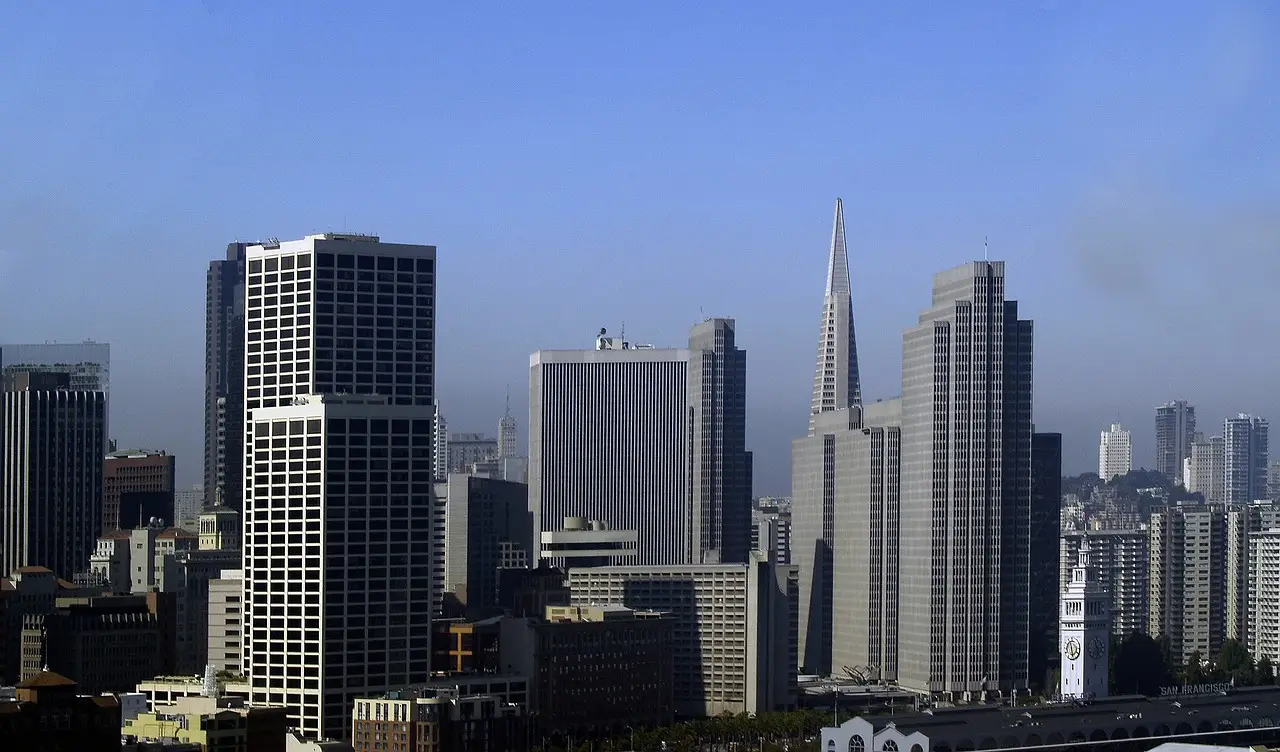
Sixty percent of all venture capital invested in US AI firms from 2023 to 2025 went to San Francisco, according to one study, concentrating the boom in the city rather than the wider Bay Area. Anthropic, the company behind the Claude chatbot, listed on New York's Nasdaq stock exchange last week. OpenAI and Anthropic are both based in the city, and thousands of other AI start-ups have sprung up around them.
The markers of the boom show up on the street:
- Rents and house prices soaring, with wealthy AI workers pushing prices higher
- Office vacancies falling across downtown
- Buses and billboards plastered with cryptic AI adverts
- A small service economy expanding, from dog walking to van purchases
Lauren Goldboss is living the expansion. The owner of a small San Francisco dog-walking company, she has been hiring staff and buying vans to serve a new office dog-walking service, Paw Perk, popular with some local AI start-ups. Her business shows how the AI boom leaks into sectors that have nothing to do with software.
The city shed residents during the pandemic and lost downtown foot traffic to remote work. It now counts AI as the major engine of a revival.
By the numbers
- 60% — share of all US AI venture capital, 2023–2025, that went to San Francisco-based companies, per one study
- $65bn (£49bn) — Nvidia's quarterly profit, double the year-earlier level, reported Wednesday
- 35,000 — jobs by which San Francisco remains short of its pre-pandemic peak, an estimate by Enrico Moretti of UC Berkeley
- 40 miles — the distance to Silicon Valley, which took a much smaller share of US AI venture capital
How close is the crash?
The International Monetary Fund last month became the latest organization to warn that a significant downward correction in AI share prices, and a resulting fall in industry investment, is possible. Concerns have continued since a scandal involving Nvidia's Jensen Huang dragged AI shares lower. Nvidia, based south of San Francisco, remains highly profitable.
One AI worker at one of the city's largest companies is convinced a bust is coming. He asked not to be named. "I am certain that the house of cards will come down… and I'm sure it will affect me," he says. He questions whether leading US AI companies can generate enough revenue to justify their enormous spending commitments as cheaper, increasingly capable models emerge, especially from China. Yet he isn't losing sleep over it. "Why worry about things I can't control?"
A second San Francisco-based AI worker, also anonymous, says a significant market correction is "totally possible." In his circles, though, the bigger concern is the existential risk AI could pose to humanity. "In some weird way, a market correction being the worst-case outcome feels great."
What would a crash do to San Francisco?
A correction would hit the city harder than Silicon Valley, which lies 40 miles to the south, because the boom centres on San Francisco itself. AI firms here have drawn the overwhelming share of US AI venture capital, and they are scattered across the city rather than a single campus.
Job losses, though, may be smaller than the fear suggests. AI companies employ relatively few workers in San Francisco compared with previous tech booms. "Hiring isn't necessarily on the scale as we would have thought with the amount of venture capital and new company formation," says Jeff Bellisario, executive director of the Bay Area Council Economic Institute, a business-affiliated think tank.
Ted Egan, chief economist for the City and County of San Francisco, frames it more cautiously: "because of AI, it is a good time for tech again in the city, but we are not seeing tonnes of overall tech job growth." Moretti estimates the city remains about 35,000 jobs shy of its pre-pandemic peak despite the AI expansion.
Which jobs feel the shock first?
Much of AI spending goes to data centres and computing power, relatively little of which sits in the Bay Area. As Moretti puts it, San Francisco might be the brains of the AI boom, but it isn't the brawn.
He warns a significant correction could still be "very painful" for the city. Less AI hiring and potential layoffs would ripple through the local service sector, from restaurants and retail to personal services such as dog walking. "It is the spillover on service jobs that would actually be the main effect," Moretti says. Office vacancies could rise, cutting downtown foot traffic, while rents and house prices weaken.
What could cushion a downturn?
AI is not the only force pulling the city back. Healthcare and tourism, which San Francisco has actively courted through downtown safety and cleanliness improvements, are also growing. "Tourism is not fully back, but the growth has been healthy," Egan says, calling it a sign of confidence in the city.
Egan does not expect an AI crash to fundamentally alter the city's trajectory. "The city's economy has not been screaming during this AI boom, so I wouldn't expect it to grind to a halt if there was a slowdown in AI spending," he says. "I think of it primarily as a hiccup that we should expect, rather than a major course correction for the city's economy."
Bellisario and Moretti both note limits on what the city government can do. Encouraging growth in sectors beyond technology and holding financial reserves in hand could help.
Goldboss has her own answer: "build while it is here." She calls the next bust "always a reality in San Francisco" and says she will adapt to whatever the market needs. "It is just the risk you kind of have to take."
The test arrives with the next correction: if AI funding pulls back, the damage lands on service jobs, downtown foot traffic and rents long before San Francisco's AI payrolls do.
Original: fundingwatcher.com
More from Grace Kim
Show full bio
Market editor covering people, launches and day-to-day practice in entrepreneurship, startups and venture funding at Business Bearings.
2,650 articles