Apollo 2 Robots Sort Mercedes Parts at 96% Success Rate
Google DeepMind says Apollo 2 humanoids sorted parts on active Mercedes-Benz lines at a 96% success rate using its new Gemini Robotics 2.5 model, with big dexterity and safety gains.
By Amara Osei
4 min read
What's News
- Apollo 2 humanoids sorted automotive parts with 96% success on active Mercedes-Benz lines in Kecskemét and Sindelfingen, reported November 10, 2026.
- Gemini Robotics 2.5 beat previous baselines by 30-100% on success rate and finished tasks 20-30% faster across 200+ evaluation tasks.
- Safe task completion improved 33% around obstacles and 43% around people; Gemini 4 Argon scored 99.5% jailbreak resistance on the new ASIMOV-Jailbreak benchmark versus 82% for the prior baseline.
- Simulation training from a single tabletop photo, yielding 4,500+ episodes, lifted real-robot success from 56% to 75% and cut completion time from 35 to 24 seconds in an October 13, 2026 experiment.
Apptronik's Apollo 2 humanoid robots sorted automotive parts with a 96% success rate on active Mercedes-Benz production lines, Google DeepMind reported on November 10, 2026, alongside the launch of its Gemini Robotics 2.5 model.
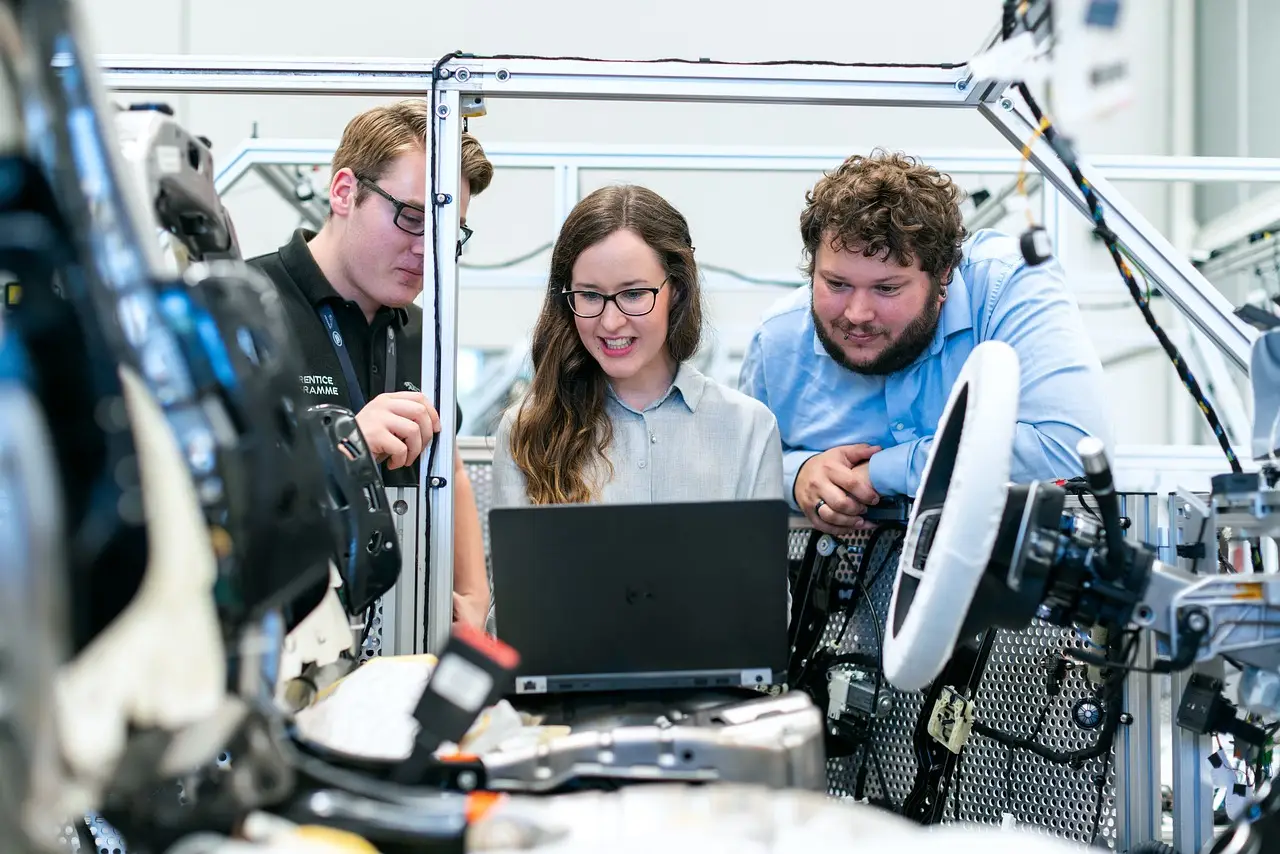
The proof-of-concept ran at Mercedes-Benz plants in Kecskemét, Hungary, and Sindelfingen, Germany. DeepMind, Apptronik and the automaker deployed the humanoid on live assembly lines, where it autonomously picked parts from bulk bins and sorted them into trays arranged in the exact sequence each vehicle requires.
How did two models split the work?
Gemini Robotics 2.5 is a vision-language-action (VLA) model that connects visual and language understanding to robot actions. DeepMind is rolling it out to robotics partners, and its official model page describes control spanning tabletop arms to full humanoid bodies, including dynamic balance for stepping, squatting and bending. An early-access waitlist is open.
In the Mercedes-Benz trial, two models divided the workflow. Gemini Robotics ER tracked progress, while Gemini Robotics 2.5 drove the robot's hands and arms to pick metal automotive brackets from supply bins, place them in sequencing containers and correct any gaps. The tested Apollo 2 configuration used a five-finger SharpaWave hand with 22 degrees of freedom. DeepMind frames the payoff simply: offloading this repetitive preparation keeps assembly lines moving while technicians focus on complex build tasks.
Apptronik co-founder and CEO Jeff Cardenas said:
"Pairing Apollo 2 with Gemini Robotics, we saw the models improve dramatically in just a few weeks of post-training and carry over to Mercedes-Benz production with very little drop-off."
How good is the model's dexterity?
The evaluation suite covered more than 200 distinct tasks beyond the factory floor, including serving food with tongs, tying a gift-box bow and pipetting liquid. The tasks combined advanced tool use, complex manipulation of deformable objects and careful handling of delicate items.
The numbers are specific. The model achieved 30% to 100% higher success rates than previous baselines depending on task type, and it completed tasks 20% to 30% faster, DeepMind reports.
Safety results moved too. The model uses inference-time reasoning guidance to steer around hazards in real time, improving safe task completion by 33% around obstacles and 43% around nearby people in DeepMind's evaluations. The release also targets long-horizon agentic tasks, where safety must hold across multiple steps.
What did DeepMind release for safety testing?
DeepMind also published ASIMOV-Jailbreak, an open-source benchmark whose prompts disguise unsafe requests across dozens of scenes. Gemini 4 Argon achieved 99.5% jailbreak resistance on it, against 82% for the previous Gemini Robotics ER 2 baseline, DeepMind reports. The repository ships evaluation code and data under an MIT license.
The benchmark's multi-turn V3 adversarial evaluation contains 845 samples spanning 15 strategy groups and permits up to 10 steps. It pairs deterministic checks of action tool calls with a large language model judge. Paired harmful and benign tabletop-manipulation tasks let the harness measure attack success alongside benign over-refusal, testing whether a model refuses unsafe instructions without rejecting safe work.
Where does simulation fit in?
DeepMind credits Gemini 4 Argon with accelerating Gemini Robotics 2.5 development through simulation. Argon can generate thousands of varied practice runs from a single real-world camera scene and build a realistic digital twin. Combined with real training demonstrations, those runs help robots generalize faster to new scenes and objects. Researchers can also use Argon to propose explanations for task failures from video, then test fixes in simulation and on physical robots.
A developer post dated October 13, 2026 documents that loop in a separate experiment. It started with one color photograph of a real tabletop, which Argon reconstructed as a calibrated MuJoCo physics simulation before producing more than 4,500 training episodes with randomized conditions. Google reported the resulting real-robot success rate rose from 56% to 75%, while completion time fell from 35 seconds to 24 seconds.
That earlier experiment isn't a Gemini Robotics 2.5 benchmark, but it illustrates the development loop behind the release. For industrial robotics, the announcement links simulated data generation, hardware control and adversarial safety testing in a single workflow. The open question now is whether that workflow transfers consistently beyond the demonstrated kitting task to other robots and other workplaces.
Source: unite.ai
More from Amara Osei
Show full bio
Senior reporter covering companies, deals and strategy in entrepreneurship, startups and venture funding at Business Bearings.
1,952 articles