Bitcoin's Difficulty Gauge Resets Every 2,016 Blocks
Every 2,016 blocks, Bitcoin resets mining difficulty to hold block times near ten minutes — a mechanism that quietly decides which miners stay profitable and which fold.
By Nathan Brooks
3 min read
What's News
- Bitcoin adjusts mining difficulty approximately every 2,016 blocks to keep the average block interval near ten minutes.
- Higher difficulty means more competition for the same block rewards, cutting the expected BTC earnings of miners who don't expand.
- Mining profitability depends on price, difficulty, electricity costs, hardware efficiency, transaction fees and the block subsidy.
- Difficulty responds with a delay and reflects technology and energy costs, not price predictions.
- In prolonged declines, less efficient miners may shut equipment or sell BTC reserves to cover costs.
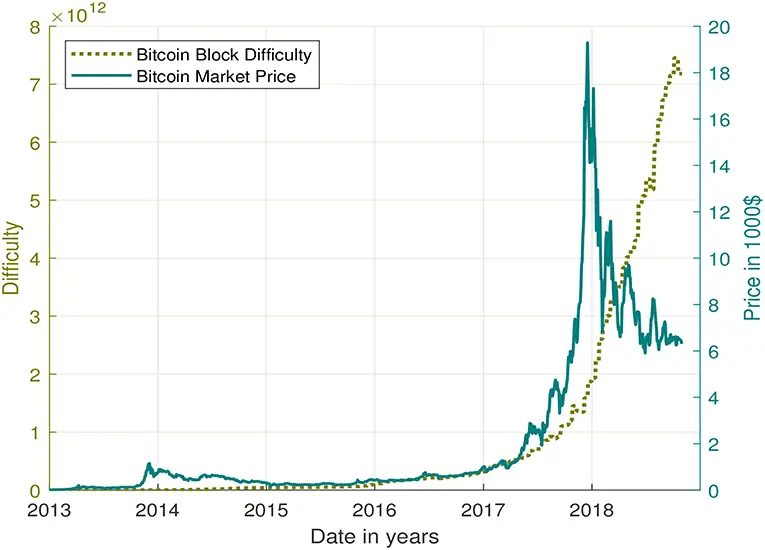
Every 2,016 blocks, Bitcoin rewrites the economics of every mining operation on the planet. That's the roughly two-week cadence at which the network adjusts mining difficulty, recalibrating how much computational work it takes to produce a valid block. Trader SamDrnda, in a TradingView analysis titled "Why Bitcoin Mining Difficulty Matters," argues this mechanism deserves far more attention than it gets next to price, trading volume and derivatives positioning.
The mechanics are simple and unforgiving. Difficulty determines how hard it is for miners to solve for a valid block, and the network resets the parameter every 2,016 blocks to keep the average block interval near ten minutes. That target holds regardless of how much or how little computing power is plugged into the network at any moment.
How the feedback loop works
When new computational power joins, blocks initially get found faster. The next difficulty adjustment then raises the required work, pulling the expected block interval back toward the ten-minute target. If substantial mining power disappears, the opposite adjustment eventually follows.
For miners, the practical consequence is brutal: higher difficulty means more competitors chasing the same block rewards. SamDrnda illustrates it with a concrete scenario. Imagine a mining company running equipment that produces a relatively stable amount of hashpower. If the total network hashrate climbs significantly while that company's own capacity stays flat, its expected share of newly mined Bitcoin declines. Electricity costs stay roughly the same, but the BTC it can expect to earn shrinks.
That squeeze is the core of mining economics. Profitability, per the analysis, depends on several interacting variables:
- Bitcoin's market price
- Network difficulty
- Electricity costs
- Hardware efficiency
- Transaction fees
- The block subsidy
What does this change for operators and traders?
For operators, difficulty is a margin pressure they can't opt out of. When Bitcoin appreciates rapidly, mining becomes more profitable, which pulls in additional investment in equipment. Over time, that increased competition pushes difficulty higher, eroding the advantage for operators who haven't expanded capacity or improved efficiency. Scale and hardware refreshes become survival requirements, not options.
The relationship cuts the other way during prolonged market declines. Less efficient miners struggle to cover operating costs, and SamDrnda notes they may respond by shutting down equipment or selling Bitcoin reserves to finance expenses — forced selling that traders watch closely.
For traders, difficulty supplies context rather than signals. It explains how competition among miners shifts over time, and how those shifts affect the profitability of producing new BTC. It is a read on the economic environment sustaining Bitcoin's proof-of-work network.
Why difficulty isn't a price oracle
SamDrnda draws a firm line here: changes in mining difficulty should not be treated as direct price predictions. Difficulty responds to network conditions with a delay, and shifts in mining activity can reflect technology improvements, energy costs, or plain operational decisions — not miners' collective view on where Bitcoin is headed.
The analysis closes with the distinction worth keeping: "Mining difficulty does not tell us where Bitcoin will trade tomorrow. It reveals how the economics of securing the network are evolving."
For anyone with exposure to BTC — through mining stocks, direct holdings or the broader crypto complex — the so-what is straightforward. Difficulty won't call the next move, but it maps the cost base of the network securing your asset. Watch the 2,016-block resets; they're the market's periodic audit of who can still mine profitably.
Source: tradingview.com
More from Nathan Brooks
Show full bio
News editor covering regulation, policy and their impact on entrepreneurship, startups and venture funding at Business Bearings.
2,866 articles