Black Lake Hired Delivery Riders to Sell AI to China's Factories
Profitable since 2025, Black Lake grew revenue over 60% a year selling AI factory software — with ex-food-delivery riders as its salesforce, founder Zhou Yuxiang told Fortune.
By Daniel Okafor
4 min read
Updated
What's News
- Black Lake says it has been profitable since 2025 with revenue growth above 60% a year.
- Founder Zhou Yuxiang spoke at the Fortune Leaders Forum in Macau on Sept. 8.
- China installed 354,000 industrial robots in 2025, 59% of the world total (IFR).
- OpenAI raised $122 billion in one round this year; Anthropic raised $65 billion.
- PopZao produced a 500-unit batch for a Buddhist temple in 30 days; it sold out within a week.
Black Lake Technologies has been profitable since 2025, with revenue growing more than 60% a year, according to founder Zhou Yuxiang — and he built that business by hiring food delivery riders instead of enterprise software salespeople.
When Zhou founded the Shanghai-based AI startup, he first did what seemed sensible: hiring salespeople from Western software giants like SAP and Siemens. But as Black Lake moved from enterprise clients to China's smaller factories — some four million of them — those polished professionals proved useless.
"They couldn't even figure out how to get into the factory, past the security guard and the guard dogs," Zhou told Fortune during the Fortune Leaders Forum in Macau on Sept. 8.
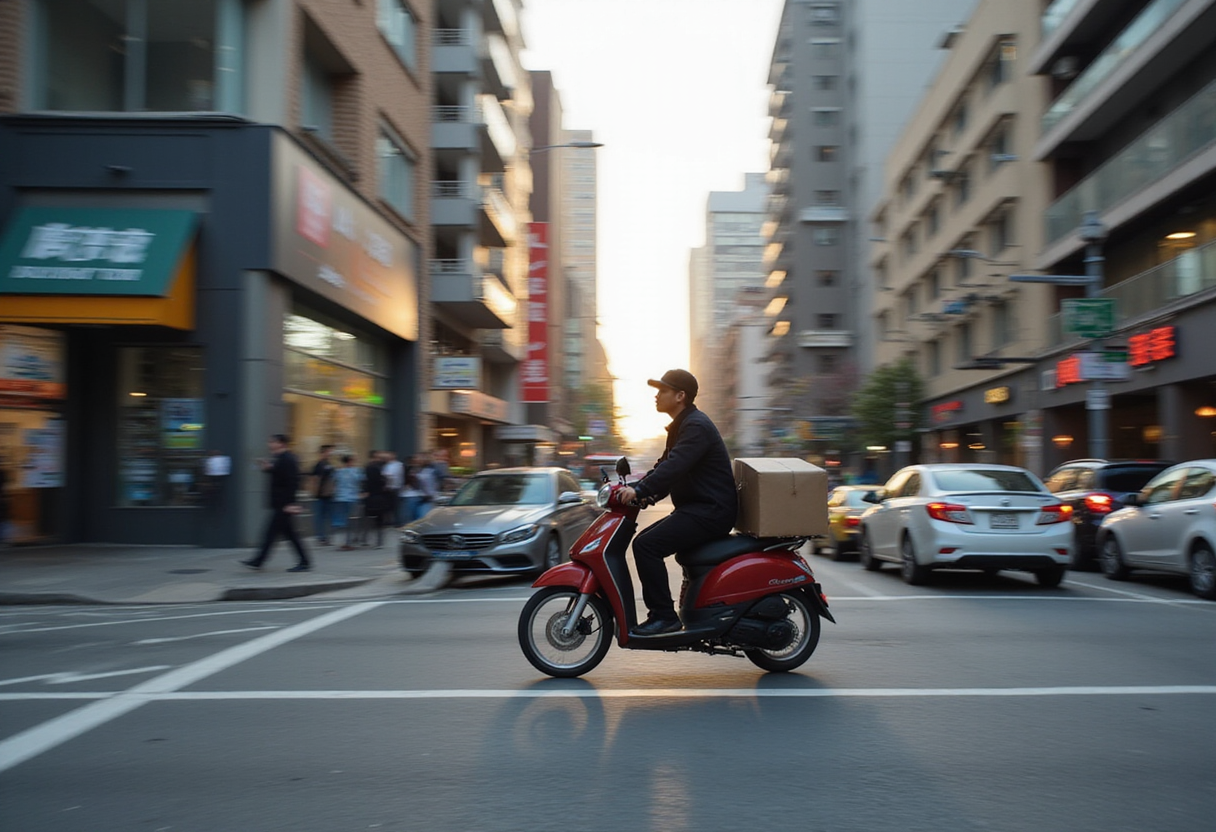
Couriers from Meituan and Alibaba's Ele.me, he found, "have the best, you know, street-smart wisdom to meet the decision makers." The riders knew the back entrances, the factory layouts, and the best path to the boss of a mom-and-pop workshop.
How do you turn riders into software sellers?
What the drivers had in nerve, they lacked in product knowledge. Zhou put every new hire through what he called a "devil boot camp":
- Five days of 14-hour training sessions
- A daily exam
- One contract closed over the phone by the final day
Only about half graduated.
Zhou, a Dartmouth grad and former investment banker, is betting that the most interesting market for AI is not the consumer smartphone nor the corporate office, but the shop floor. Black Lake sells cloud-based factory-management software that tracks orders, schedules, materials, and output — plus AI agents that read an incoming order, generate a quote, and schedule production on their own.
His larger wager: that AI can restructure how an industry operates, not just make existing work faster. "I don't think the Google moment has happened yet in the AI era, because we are only replacing [tasks]," he said. "I don't think we have restructured the industry."
What happened to his first startup?
Black Lake is Zhou's second attempt. In 2015, he and two high school friends returned to China to found MadaData, which Zhou describes as "a Palantir for China." It flopped. "It turned out most of the factories that we visited back then had zero data," Zhou says.
As the team liquidated MadaData, a group of second-generation factory owners — "forced by their family to take over [the] family business" — stepped in. Educated abroad like Zhou, they faced a market shifting toward smaller orders with faster turnarounds.
This time, Zhou went hands-on. "We thought we should really go into the factory instead of locking ourselves up in the room and coding," he said. He took a job on a plastic-injection line at a factory making cosmetics for a European giant, working alongside migrant laborers from Sichuan and Guizhou. He timed a six-hour changeover between batches and found only one hour of it useful. The rest was wasted on "subjective decision-making" and information silos.
Can China leapfrog digitization?
China installed 354,000 industrial robots in 2025 — a record 59% of the world's total, according to the International Federation of Robotics. Open-weight models from Alibaba, DeepSeek, Z.ai, and Moonshot AI now deliver near-frontier performance at a fraction of the cost of closed Western rivals.
Still, constraints loom. U.S. export controls deny China frontier AI processors, and China's funding pool is far shallower than America's: OpenAI raised $122 billion in a single round this year, Anthropic $65 billion — totals no Chinese company can match.
Zhou sees the biggest challenge as internal. "I think we're racing against ourselves," he said. "Time is the limited resource for us."
Onstage in Macau, he dismissed the idea that China can skip the software era. "People always have this wishful thinking that we're going to skip the software time and go directly into AI, just like we skipped the credit card era into mobile payments," he said. "Unfortunately, I think in China we still have a lot to do with digitization." As frontier models converge, he argued, data preparation and accumulation have become "an industry question."
What is PopZao?
Zhou's attempt at an answer is PopZao, a website and WeChat mini program incubated for two years. It connects China's factories with its creator economy: Black Lake's agents convert ideas into designs, a 3D simulation, and industrial data sent to a factory.
One early customer was a Buddhist temple seeking merchandise for younger visitors. After the temple's master submitted a photo of its stone lions, Black Lake designed and manufactured a batch of 500 units in 30 days. They sold out within a week. "Now the temple is taking pictures of trees, the dogs, cats, different kinds of things as their souvenirs," Zhou said.
He won't claim that constitutes the breakthrough. "The real Google moment should happen only when you restructure the industry rather than replace human beings," he said. "This is what I'm working so hard to see — whether the Google moment can happen sooner than later in our industry."
Original: ele.me
More from Daniel Okafor
Show full bio
Correspondent covering business strategy at Business Bearings.
585 articles