Blue Tech Startups Near $10 Billion as Maritime Economy Hits $2.6 Trillion
Blue tech scaleups raised almost $10 billion through Q3 2026, topping all of 2025's $6.2 billion. Anduril's $5 billion round leads a surge in maritime-focused funding.
By Grace Kim
4 min read
What's News
- The blue economy has doubled in 25 years to $2.6 trillion, which would rank as the world's fifth-largest economy if it were a country.
- Blue tech scaleups raised almost $10 billion through Q3 2026, exceeding the $6.2 billion raised in all of 2025.
- Anduril Industries raised $5 billion in 2026 and Helsing raised $1.8 billion, driving much of the sector's surge.
- Blue tech has averaged 70 new scaleups per year since 2021, with roughly 100 expected in 2026.
- AI, machine learning, robotics and automation account for more than 200 scaleups and $20 billion invested.
Blue tech startups have raised almost $10 billion through the third quarter of 2026 — already surpassing the $6.2 billion they collected in all of 2025, according to Mind the Bridge's "Rethinking the Blue Economy" report, produced with support from Crunchbase. The sector's broader backdrop is just as large: the "blue economy," the cluster of industries built around oceans and coasts, has doubled in size in a quarter of a century to reach $2.6 trillion in value.
That scale deserves a benchmark. As report author Alberto Onetti, chairman of Mind the Bridge, puts it: if the blue economy were a country, it would be the world's fifth largest.
The sector spans shipping, fisheries, offshore energy and marine biotechnology. For startups, Onetti writes, that means opportunities to modernize how the world moves goods, produces energy and manages marine resources. The forces driving change are digitalization and automation, the energy transition, environmental pressures and advances in marine biotechnology — all reshaping how value gets created at sea.
Which deals are driving the money?
The surge has a distinctly defense-shaped core. Mind the Bridge attributes much of the 2026 jump to "exceptional maritime resilience deals" involving defense and infrastructure companies. Two names dominate:
- Anduril Industries, which raised $5 billion in 2026
- Helsing, which raised $1.8 billion in 2026
Those two rounds alone account for a large share of the nearly $10 billion total. Strip them out, and the funding picture looks far more modest.
The growth defies the broader market. Against a global innovation slowdown, blue tech has climbed almost continuously since 2021, producing an average of 70 new scaleups per year — and accelerating over the past two years. Preliminary figures for 2026 suggest roughly 100 new blue tech scaleups could emerge by year-end.
The funding numbers tell the same story. The $6.2 billion raised in 2025 was double the previous year's total. If the current pace holds, Mind the Bridge expects the sector to attract more than $12 billion by the end of 2026.
In short: blue tech is one of the few startup categories compounding through a down market.
How mature is the technology?
Not every corner of blue tech is moving at the same speed. To map the sector, Mind the Bridge clustered every unique technology developed by blue tech scaleups into 20 groups, then scored each group on two axes: industry impact and market commitment, a measure combining scaleup density and capital invested.
The matrix separates the field into clear tiers:
- Transformational technologies — high impact and relatively well-established. AI and machine learning, plus robotics and industrial automation, occupy the sweet spot, with more than 200 scaleups and $20 billion invested in total.
- High-potential disruptive technologies — smaller bets, with roughly 50 scaleups and $3 billion to $5 billion invested per cluster. The most promising here, per the report: maritime clean propulsion and sustainable fuels, and supply chain and freight tech.
The remaining quadrants hold transversal technologies with a more indirect industry impact, and emerging niche technologies.
The takeaway: capital has concentrated in AI and automation, while cleaner propulsion and freight tech remain comparatively underfunded relative to their disruptive potential.
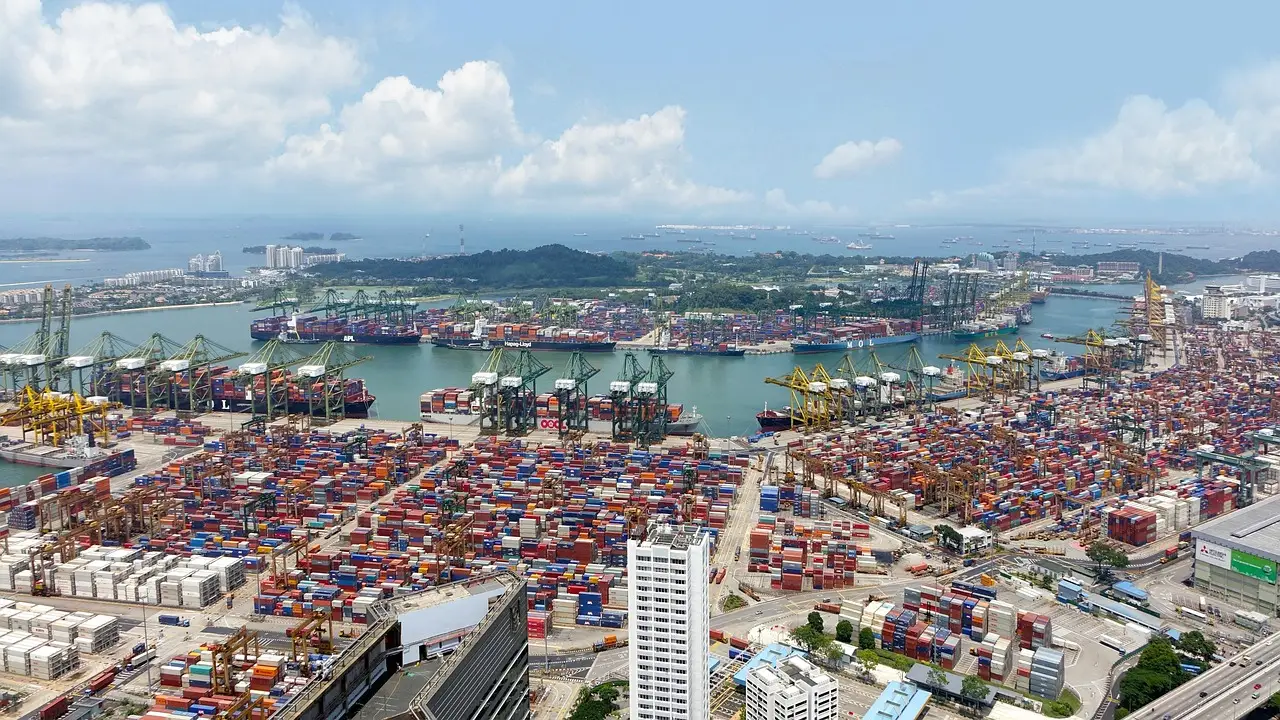
Why are ports the sector's proving ground?
Onetti's answer to who rides the blue economy's wave is blunt: ports.
Ports are where the forces reshaping maritime activity converge most visibly, functioning as miniature blue economies. He calls them the "smartest smart cities" — dense, complex systems where energy, logistics, data, mobility and people meet, and where innovation can be tested at scale before spreading to the wider economy. Like smart cities a decade ago, he argues, ports now need a playbook.
To build one, Mind the Bridge interviewed 10 of the world's leading port authorities about their priorities, challenges and barriers to innovation. The report collects case studies from the ports of Barcelona, Bergen, Seattle, Rotterdam and Los Angeles — described as true blueprints of best practice.
Most ports are already activating multiple open innovation tools, some with structured approaches and dedicated units. The standout example is BlueTechPort at the Port of Barcelona, a collaborative hub connecting entrepreneurs, technology providers, researchers and maritime businesses. The initiative is now expanding internationally through the Lighthouse International Acceleration Program, powered by Mind the Bridge.
Onetti's framing is nautical but direct: "the course of blue economy innovation is set. The challenge now is to catch the favorable winds — and ride them." The gap he identifies is coordination — port authorities, operators, startups, investors and policymakers still lack a shared agenda. Closing that gap, not more capital, is what determines whether the $12 billion trajectory becomes a durable market rather than a defense-driven spike.
Original: crunchbase.com
More from Grace Kim
Show full bio
Market editor covering people, launches and day-to-day practice in entrepreneurship, startups and venture funding at Business Bearings.
2,419 articles