FAA's $875 Million AI System Goes National — Three Days Before Ground Stop
The FAA's $875 million SMART AI system went nationwide Nov. 10 — three days before a nationwide ground stop. Officials deny any link; lawmakers want a GAO audit.
By Nathan Brooks
4 min read
What's News
- The FAA expanded the $875 million SMART AI system to all 22 air traffic control centers on Nov. 10, three days before the nationwide ground stop.
- In fall testing, SMART rerouted 180 flights, saving an average of 10 minutes and 80 gallons of fuel per flight.
- House Democrats requested a GAO audit of SMART in an Oct. 13 letter citing safety and guardrail concerns.
- ASI CEO Phillip Buckendorf says AI computes but humans decide: "they are the decider, they are the judge."
- The controllers' union represents about 14,000 controllers, roughly 3,000 of them trainees.
The FAA expanded its $875 million AI-powered SMART system to all 22 U.S. air traffic control centers on Nov. 10 — three days before a communications failure grounded flights nationwide, and officials are now working to convince the public the two events are unrelated.
Homeland Security Secretary Markwayne Mullin said Friday there's no indication the ground stop is linked to the new system, and the top officials at the Transportation Department and the FAA repeated that denial Saturday. Air Space Intelligence (ASI), the startup that built SMART, said the ground stop wasn't caused by "the SMART system, any product of ASI or our integration with FAA and ATC."
The timing is doing the agency no favors.
What does the SMART system actually do?
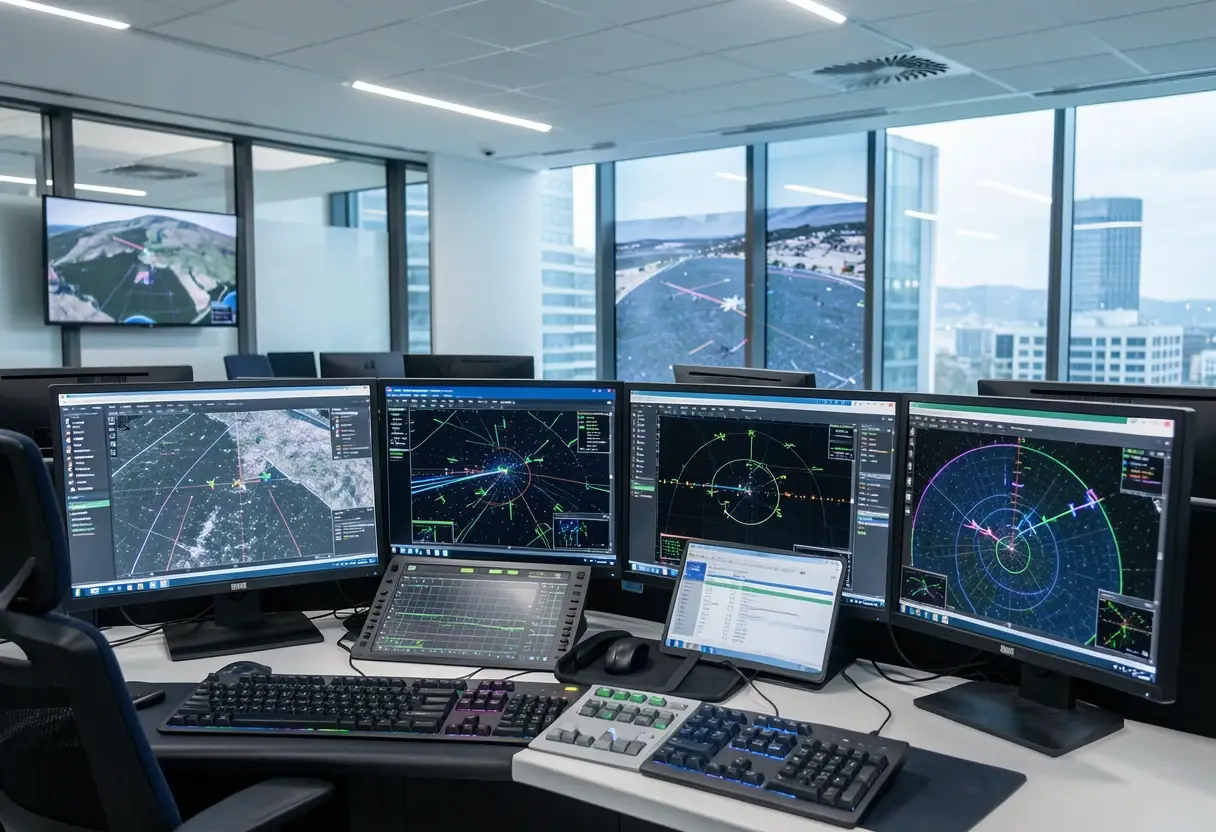
Transportation Secretary Sean Duffy and FAA Administrator Bryan Bedford unveiled SMART in September, calling it a "cutting-edge tool that centralizes 200 data streams — including weather patterns, flight paths, traffic flow, and controller staffing metrics — into one platform." SMART stands for Strategic Management of Airspace, Routes and Trajectories.
The system runs from a single location near Washington, where specialists analyze flight schedules, weather forecasts and hundreds of other data streams. That office sends recommendations to the FAA's command center, which relays them to controllers across the country for consideration. The AI doesn't control flights — humans decide whether to act on its advice.
The early returns look decent on paper. During its Washington-area test this fall, the FAA says SMART helped reroute 180 flights and saved an average of 10 minutes and 80 gallons of fuel per flight. One flight from Tampa to Dallas cut 42 minutes off its trip.
A government fact sheet says SMART can predict where traffic is headed, identify alternative routes before congestion hits, reopen restricted airspace faster and manage airport arrivals. It also tackles a specific inefficiency: the FAA currently blocks weather-affected airspace in "large, rectangular boxes," which doesn't match how storms actually behave — they're "often irregular in shape, with narrow gaps or corridors that aircraft could safely fly through," according to the fact sheet.
No other country has a working AI air traffic tool like it, says Michael McCormick, a former FAA airspace manager who now teaches at Embry-Riddle Aeronautical University. Eurocontrol is testing one; several manufacturers are prototyping similar systems.
Why are lawmakers worried?
House Democrats sent a letter to the Government Accountability Office last month requesting an audit of the software, citing safety and guardrail concerns.
"Concerningly, the nation's front line aviation safety workforce apparently had little to no input into SMART's development and have received limited training and information during the current deployment process," the Oct. 13 letter said. It also flagged the AI's "potential to interfere with decision-making by experienced air traffic controllers or to hallucinate safety-critical information."
The hallucination worry isn't theoretical hand-waving. Advanced AI models fabricate false information and present it as fact, and the deployment puts AI in a pipeline where human lives are at stake.
Mike O'Donnell, a former top FAA official with 17 years at the agency who now consults on aviation safety, said the FAA "has got to make sure that this is just a tool in the toolbox and not the actual machine that's doing the work." The agency, he said, "cannot afford to be wrong on this."
"There's got to be a way to verify and validate what it's doing to make sure that it's not the wrong information," O'Donnell said. He cautioned against over-trusting the system "until we know for sure that it's proven itself time and time again. And that's going to take a while."
What does this change for controllers and airlines?
The rollout lands on top of a controller shortage the National Air Traffic Controllers Association has flagged for more than a decade — it told Congress back in 2015 the shortage was at crisis level, after the FAA missed hiring targets five years running. The union represents about 14,000 controllers, roughly 3,000 of them trainees.
Experts say no AI system can replace controllers, who train for years for one of the most demanding jobs in aviation. ASI co-founder and CEO Phillip Buckendorf framed the division of labor in an October NPR interview: "The AI does the math, the AI does the computation," he said, but "they make the decision, they are the decider, they are the judge."
With the GAO audit request pending and the ground stop still fresh, SMART's first nationwide test is as much political as technical: the system's future depends on proving the AI assists controllers without ever feeding them bad information.
Source: Fast Company
More from Nathan Brooks
Show full bio
News editor covering regulation, policy and their impact on entrepreneurship, startups and venture funding at Business Bearings.
2,232 articles