Ford's Farley: AI Has Erased the Line Between Engineers and Trades
Ford CEO Jim Farley says engineers and skilled-trades workers now share one blurred role as AI reshapes factories — and Verizon's Schulman sees AGI in 18 months.
By Nathan Brooks
3 min read
Updated
What's News
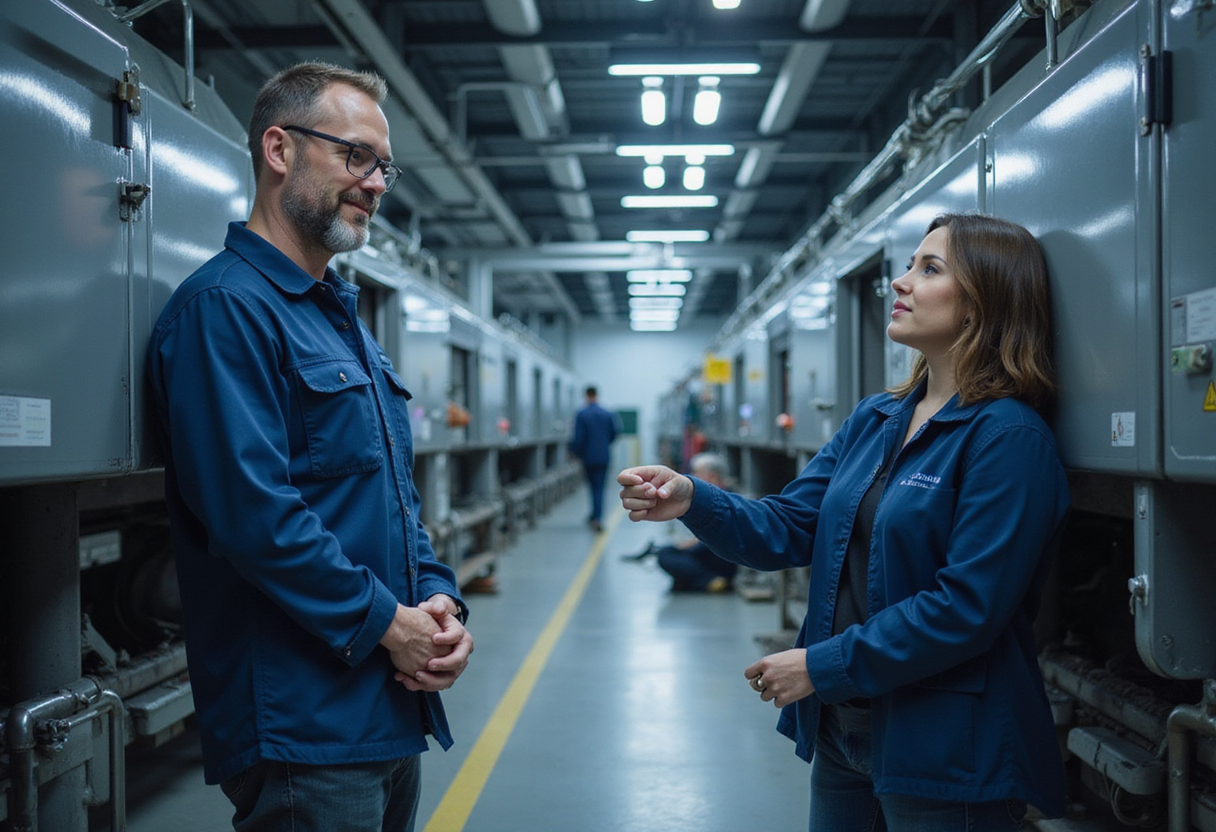
- Ford CEO Jim Farley said in Detroit that the line between engineers and hourly skilled-trades workers "is completely blurred out" due to software, robotics, and machine learning.
- Verizon CEO Dan Schulman predicts AGI within six to 18 months, quantum two years later, and humanoid robots outperforming humans by 2030.
- At Fortune's inaugural AIQ Summit, Fortune 500 chief people officers said AI has killed the org chart; Lennar's Drew Holler told workers, "it's your responsibility to upskill yourself."
Ford CEO Jim Farley says the line between engineers and hourly skilled-trades workers "is completely blurred out" as software, robotics, and machine learning reshape the assembly line. Farley made the comments in Detroit this week at the Ford Accelerate Summit, and his framing captures a broader shift: CEOs across the Fortune 500 are rethinking how they train workers in the age of AI.
The evidence piled up on two coasts this week. At Fortune's inaugural AIQ Summit in New York, a panel of Fortune 500 chief people officers told editor-in-chief Alyson Shontell that AI has killed the org chart. "We're going to give you all the tools," said Drew Holler of homebuilder Lennar, "but it's your responsibility to upskill yourself."
That message can land as empowering or demoralizing, depending on a worker's view of AI and ability to master it. The job of a leader in this climate is not just to deploy new technologies but to leverage them to reimagine work and reinvigorate workers. Conversations with CEOs at the Ford Accelerate Summit, plus study of companies deploying AI successfully on Fortune's new AIQ 75 ranking, point to three approaches.
Build a learning organization for every worker. The skilled trades have long been treated differently from white-collar careers. You train to be an electrician to be an electrician; the aperture narrows to a license and a job for life. That model no longer matches how careers actually unfold. Dallas Sutton, a 17-year-old celebrated in Detroit for studying to become an auto mechanic, told Fortune she also wants to be a vet. She enjoys mechanic work, wants to fix her own car, earn good money to pay tuition, and get credentials to become a part-time firefighter. What is different now, the reporting notes, is that the figuring-out never ends, as AI remakes work people thought they had settled into.
Make it cool. Dave Regnery, CEO of Trane Technologies, is building learning labs for skilled-trade workers modeled on programs that train athletes. He wants the programs to feel innovative, cutting edge, and cool. Dan Peyovich of Dycom, who started out as a carpenter, is taking a holistic approach: expanding benefits and adding training in topics like personal finance so employees who string fiber wiring and maintain telecom infrastructure see their jobs as a career. Patti Poppe of PG&E described employees dangling from ropes off helicopters, making work at the utility sound like an extreme sport.
Tackle the tough stuff. Verizon CEO Dan Schulman, asked about the skills shortage, immediately pivoted to existential questions about AI's impact on society and the nature of work itself. He believes we'll "get to some form of AGI [artificial general intelligence] in the next six to 18 months." Two years after that, in his prediction, comes "the era of quantum." He forecasts humanoid robots could be outperforming humans by 2030. If that timeline holds, convincing kids to consider a career in construction may not be society's biggest problem.
Schulman's outlook carries a darker tone than most, shaped in part by his years in Silicon Valley as CEO of PayPal. He is now working to make Verizon's 250,000-plus workers and contractors more nimble, innovative, and determined to win. The possibilities drew him away from retirement on his Montana ranch, where he lives with his wife, a bunch of bears, and 500 head of cattle. Does the pace of AI ever tempt him back to the cowboy life? No. "I'm loving it," he said walking offstage. "What a time to compete!"
The contrast between Farley's blurred assembly line and Schulman's 18-month AGI clock frames the retraining challenge for corporate America: the skills gap is closing and reopening at the same time, and companies that treat learning as a continuous, company-wide function — not a one-time credential — are the ones positioned to keep up.
Original: conferences.fortune.com
More from Nathan Brooks
Show full bio
News editor covering marketplaces and e-commerce at Business Bearings.
428 articles