Genesis AI Raises $500 Million for Dexterous Humanoid Robots
Genesis AI raised $500 million to scale dexterous humanoid robots. A TechCrunch rerun exposed a botched box and difficult label, sharpening doubts about lab-to-factory reliability.
By Olivia Hart
5 min read
What's News
- Genesis AI announced a $500 million Series A led by Khosla Ventures, Premji Invest and Eclipse.
- Genesis AI was founded in 2024 and announced a $105 million seed round in July 2025.
- Sensor gloves and headset cameras have been worn by more than 100 workers worldwide.
- Genesis AI has built 30 to 40 Eno humanoids and chose a U.S. manufacturing contractor for next year.
- Eno’s dexterous hands last only a few weeks of regular work before replacement.
By Olivia Hart
Genesis AI announced a $500 million Series A led by Khosla Ventures, Premji Invest and Eclipse to deploy its humanoid robots. The financing is nearly five times the $105 million seed round Genesis AI announced in July 2025. TechCrunch’s report did not disclose a valuation or other deal terms.
What did the robot actually complete?
At Genesis AI’s Silicon Valley facility, its physical AI model controlled two off-the-shelf robotic arms during a TechCrunch demonstration. The arms picked up two small cardboard boxes, scanned them, placed them in a larger box, folded it closed, taped it shut, then removed a label from printer tape and applied it.
TechCrunch called the sequence impressive and said complex workflows of that kind still challenge robots. The company did not let the reporter test the setup, according to TechCrunch, but agreed to repeat the presentation. On the second run, TechCrunch observed the robot fumble a box and struggle to peel the tiny adhesive label from the printer tape.
A Genesis AI executive described such failures as “hiccup data,” which can improve a model. CEO and co-founder Zhou Xian separately claimed that Genesis AI had “cracked dexterous manipulation.” TechCrunch framed the unresolved gap between lab demonstrations and reliable automation as a risk of another robot winter.
Takeaway: The demo showed dexterity under controlled conditions, not dependable automation in production.
How does Genesis AI create training data?
Genesis AI was founded in 2024 by Zhou Xian and president Théophile Gervet, who met as graduate students in a Carnegie Mellon University lab. Its strategy combines generating most of its training data, developing its own generative AI model and designing the humanoid alongside both. Xian said: “We wanted to ship the best robot, end-to-end product.”
More than 100 workers worldwide wear sensor-enabled gloves and headset cameras, and their activities feed a training dataset used by the model. TechCrunch described force data as apparently the unlock for effective manipulation. Genesis AI’s robots wear the same sensor-equipped gloves, while their hands mimic human proportions.
Xian said that fidelity enables sorting and wire manipulation. TechCrunch said the focus on dexterity and the right data distinguishes Genesis AI from competitors including Figure and Agility. The report did not publish comparative performance results.
Genesis AI has also invested in simulation. Adviser Minchen Li co-authored an influential physics algorithm that the startup uses to create millions of high-fidelity models of the robot’s experience. The report disclosed no benchmark showing how much the simulated data improves performance.
Takeaway: Genesis AI’s edge, if reproducible, comes from joining proprietary data, simulation, model development and hardware design.
Can Eno move from pilot to production?
Xian said the model was more capable while operating Eno, Genesis AI’s flagship humanoid robot. Genesis AI kept Eno from demonstrating those abilities for TechCrunch, leaving the company’s central product claim untested in public.
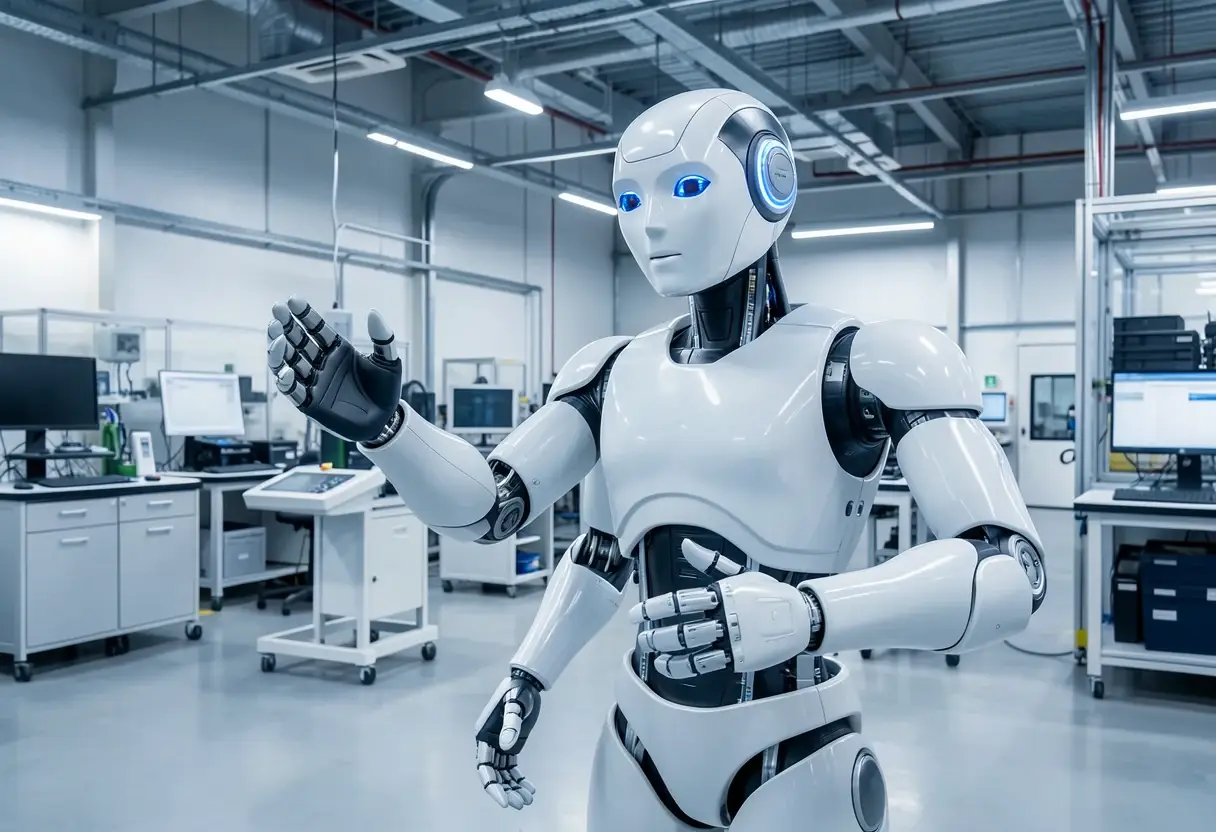
Genesis AI said Eno reflects “the feeling” it wants to deliver to customers. The machine reportedly draws on the late Steve Jobs’s influence in both design and marketing, with less of a Terminator-style metal skeleton and more of an iMac on wheels.
Genesis AI has built 30 to 40 Enos but would not disclose its production target for the following year. The company chose a mass-manufacturing contractor to begin work next year in the United States and said it had finalized the mass-produced design. It is also piloting Eno with a handful of undisclosed customers.
The announcement did not specify unit costs, customer identities or a delivery schedule. Those omissions leave the size of the near-term manufacturing opportunity unclear.
Takeaway: Eno has a pilot base and a contractor, but no disclosed scale or customer proof.
What blocks reliable deployment?
Xian identified hardware capability as the key bottleneck, including mechanical design and the supply chains needed to produce industrial-grade machines. Genesis AI’s dexterous hands can operate for only a few weeks of regular work before they need replacement. That limit leaves open questions about uptime and service costs.
The company did not disclose replacement costs, operating-hour tests or a target for longer-lasting hands. A successful box-packing demonstration does not establish performance across the variability of an industrial deployment.
Xian said truly generalized robotic intelligence requires more data. He dismissed distinctions between Vision-Language-Action models and World-Action models, arguing that software ultimately comes down to transformers and attention.
His priority is infrastructure: “what really matters is is the whole infra — the training infrastructure, the data infrastructure, and the quality of the data.” He estimates that “the model architecture contributes to maybe 10% of of the final [result].” TechCrunch reported no benchmark or independent test behind that estimate.
Takeaway: Genesis AI puts more weight on data and infrastructure than model design, but offers limited proof for the split.
Can execution close the gap?
Xian does not expect another fundamental scientific leap: “I don’t think we expect or we need another fundamental scientific leap. No, we have all the recipes. It’s just about execution.” Genesis AI’s remaining tasks are concrete: improve reliability, extend hand life, secure industrial supply chains and scale the U.S. build.
Those claims set a demanding test. The contractor plans to start next year, but success will hinge on whether Eno can maintain output without repeated hand replacement and whether undisclosed pilots become repeatable production work.
Takeaway: The next proof point is repeatable factory work, not a more polished demo.
Original: genesis.ai
More from Olivia Hart
Show full bio
Staff writer covering people, launches and day-to-day practice in entrepreneurship, startups and venture funding at Business Bearings.
2,224 articles