Hiyd's 7-Gram Sensor Turns Any Watch Into a Health Tracker
Ex-Apple engineer Salah Batroukh's Hiyd sticks a 7-gram, 2.7 mm sensor under any watch via microsuction. 16,000 deposits are already in; Kickstarter lands in November.
By Grace Kim
4 min read
Updated
What's News
- Hiyd's sensor is 2.7 mm thick, weighs 7 grams, and attaches via a 0.3 mm microsuction layer — no magnets or adhesive.
- Over 16,000 people have made deposits to secure Hiyd's first units ahead of a November Kickstarter launch.
- Founder Salah Batroukh spent about seven years as a manufacturing design engineer at Apple.
- Hiyd is one of the top 20 companies competing in Startup Battlefield at TechCrunch Disrupt on Wednesday.
- Co-founder Mahamad Charawi previously co-led Y Combinator-backed Laudspeaker through its sale.
By Grace Kim
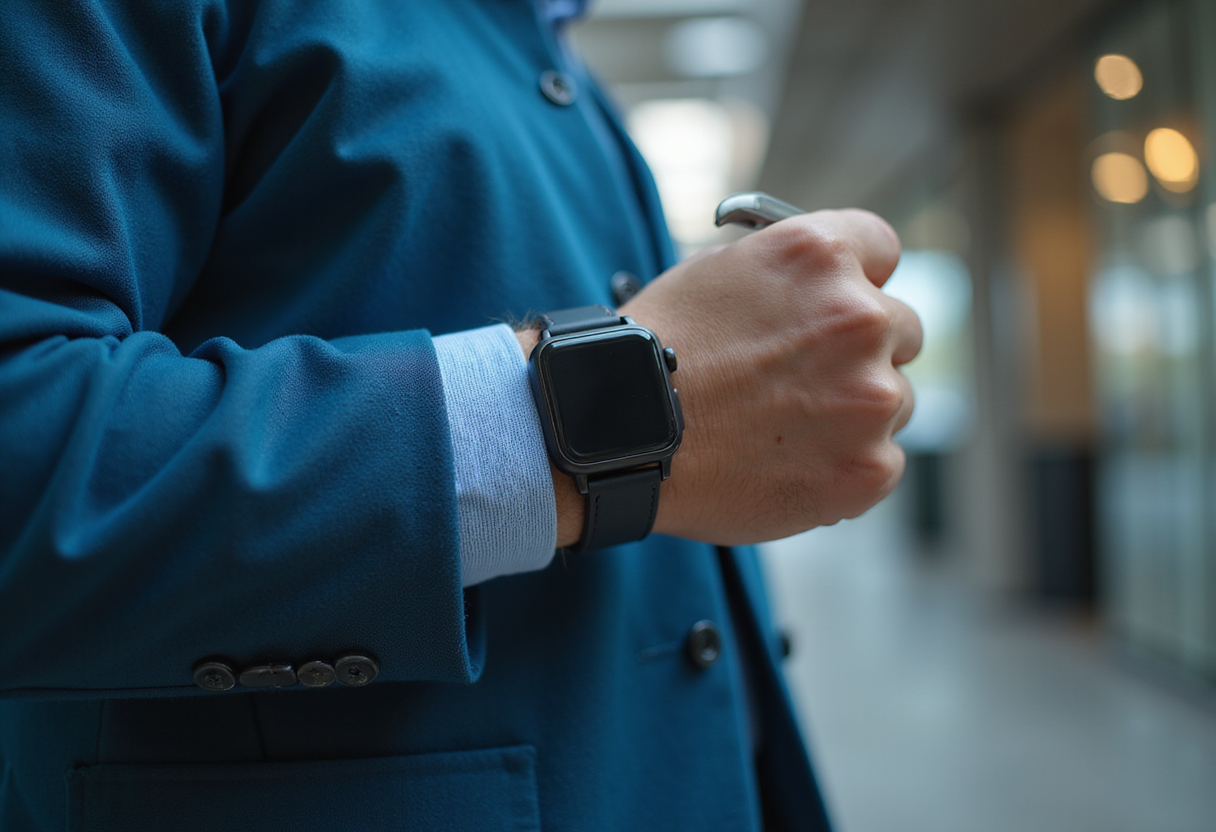
More than 16,000 people have already put down deposits for Hiyd, a health sensor that measures 2.7 mm thick, weighs 7 grams, and sticks to the back of the watch you already own.
Hiyd founder Salah Batroukh, who spent about seven years as a manufacturing design engineer at Apple, built the startup on a simple premise: people shouldn't have to swap a prized timepiece for a bulky fitness band.
"We don't think that health tracking needs to be this overly conscious decision where you have to change something about the way you look," Batroukh told TechCrunch. "That's the ethos of the entire company. Our plan is to build out this product ecosystem of invisible health tracking."
That's 16,000 deposits before a single unit has shipped. Hiyd plans to launch a Kickstarter in November.
How does the sensor attach without glue or magnets?
The disc fastens via microsuction — a textured silicone sheet with hundreds of tiny pockets per square inch. Press it against the watch back and it pushes air out of those pockets, creating a vacuum. No adhesive residue, no magnets interfering with watches that keep time magnetically.
"Microsuction is essentially a textured silicone, with hundreds of tiny pockets per square inch molded into a pliable sheet. So when you press on it, it pushes air out of all those pockets, and you end up with a vacuum — just like traditional suction cups but scaled down incredibly," Batroukh explained. "It works incredibly at stopping shear forces, but a little bit of prying allows it to pop right off, which is ideal for us. It's also incredibly thin at just 0.3 mm with our manufacturing processes."
The attachment layer is 0.3 mm thin. The whole sensor sits flush under the watch head — the invisible part of the "invisible health tracking" pitch.
What does it actually measure?
According to Batroukh, the device collects biometrics comparable to leading wearables:
- Heart rate and heart rate variability
- Sleep staging
- Movement
- Calories burned
- VO2 max estimations
Data syncs to an iOS or Android app. To fine-tune the sensor, Hiyd's team films themselves doing activities and labels the resulting data sets to train its AI.
"We go for a walk and say, 'This is somebody walking, this is somebody jogging, this is somebody running,'" Batroukh said. "The one thing that AI is really good at is data analysis, so we can basically fit a lot of heuristic analysis into our sets really quickly."
Cheap labeled data, fast model tuning. That's the engineering loop behind the biometrics.
Will the app go beyond fitness stats?
Hiyd is also building nutrition tracking into the app. The stated goal isn't calorie counting — it's connecting eating habits to sleep quality and workout performance.
"What we will do is say like, 'Hey, on days where you work out at 10 pm instead of 10 am, your sleep quality is actually worse,' and that'll be specific to you," Batroukh said. "Or it'll say, 'Hey, we think you had a less deep sleep last night because you had a slice of cake before you went to bed, and the sugar affected it.'"
Personalized correlations, not generic advice. That's the wedge Hiyd wants against Apple Watch, Oura, and Whoop.
Who is building it?
Batroukh left Apple because he wanted to test whether he could design great hardware without a multitrillion-dollar brand behind him.
"One of the reasons I left Apple was a lot of the products became a little bit more about being an Apple product, rather than being something for the customer," he said. "[Hiyd] gives me the opportunity to do the exact opposite."
He's joined by two co-founders:
- Omar Shakir, CTO, an experienced mechanical engineer
- Mahamad Charawi, head of software, who previously co-led the Y Combinator-backed startup Laudspeaker through its sale
What's next?
Hiyd competes at TechCrunch Disrupt this Wednesday as one of the top 20 companies in Startup Battlefield. The Kickstarter follows in November, with 16,000 deposit-holders first in line.
If those deposits convert at even a modest rate, Hiyd enters crowdfunding with more validated demand than most hardware launches ever see.
Original: hiyd.ai
More from Grace Kim
Show full bio
Market editor covering people, launches and day-to-day practice in entrepreneurship, startups and venture funding at Business Bearings.
814 articles