INFevo Raises Over RMB 100M Pre-A to Scale AI Virtual-Cell Platform
INFevo raised over RMB 100M in Pre-A funding, its second round in five months, to scale AI virtual-cell models, automated wet labs and pharma collaborations — but benchmark claims have limits.
By Nathan Brooks
3 min read
What's News
- INFevo raised over RMB 100 million in Pre-A funding announced November 16, 2026, its second round in five months after a June 2026 angel round.
- Xinglian Capital called the round a record single-round financing for a Chinese virtual-cell company.
- Karl Workbench ranked first in single-cell and spatial omics on SciAgentArena's ~200-task benchmark in an October 2026 retest, running on DeepSeek.
- The OCOO-T model reports state-of-the-art results on Tahoe100M, Replogle and PBMC benchmarks.
- INFevo joined a Beijing key laboratory led by Peking University First Hospital on tumor organoid culture.
INFevo has raised more than RMB 100 million (roughly $14 million) in Pre-A funding, its second financing in five months, to expand AI virtual-cell models and automated experimental systems. Xinglian Capital announced the round on November 16, 2026, calling it a record single-round raise for a Chinese virtual-cell company.
Xinglian Capital, Prosperity7 Ventures, Huagai Capital, Huakai Fund and DT Capital joined the round. Existing investors Shunwei Capital, HSG and Songhe Capital added capital. The new money follows an angel round of tens of millions of yuan closed in June 2026, and will also fund deeper collaboration with pharmaceutical companies, hospitals and research institutions.
What does the virtual-cell model actually do?
INFevo's core product predicts how cells respond to drug or genetic interventions before any lab work starts. Researchers can compare potential targets, rank candidate molecules and reserve wet-lab capacity for the most promising questions. That's the pitch; the mechanics live in a technical paper.
The OCOO-T model is a minimalist flow-matching system whose standard Transformer stack runs directly on continuous gene-expression profiles. Prediction works as continuous-time denoising, with perturbation, dosage and cell-line or cell-type data entering through adaptive layer normalization and in-context tokens.
The authors report state-of-the-art results across three benchmarks: Tahoe100M, Replogle and PBMC, covering chemical, genetic and cytokine perturbations. The model also scales to long transcriptional profiles through a patching-and-depatching technique for cellular contexts.
XtalPi, which incubated INFevo, laid out the industrial logic in a July 16, 2026 announcement. Its molecular-design and automated-synthesis capabilities complement INFevo's predictions, forming a chain from molecular generation to cellular-response prediction to experimental validation.
How does the lab loop close?
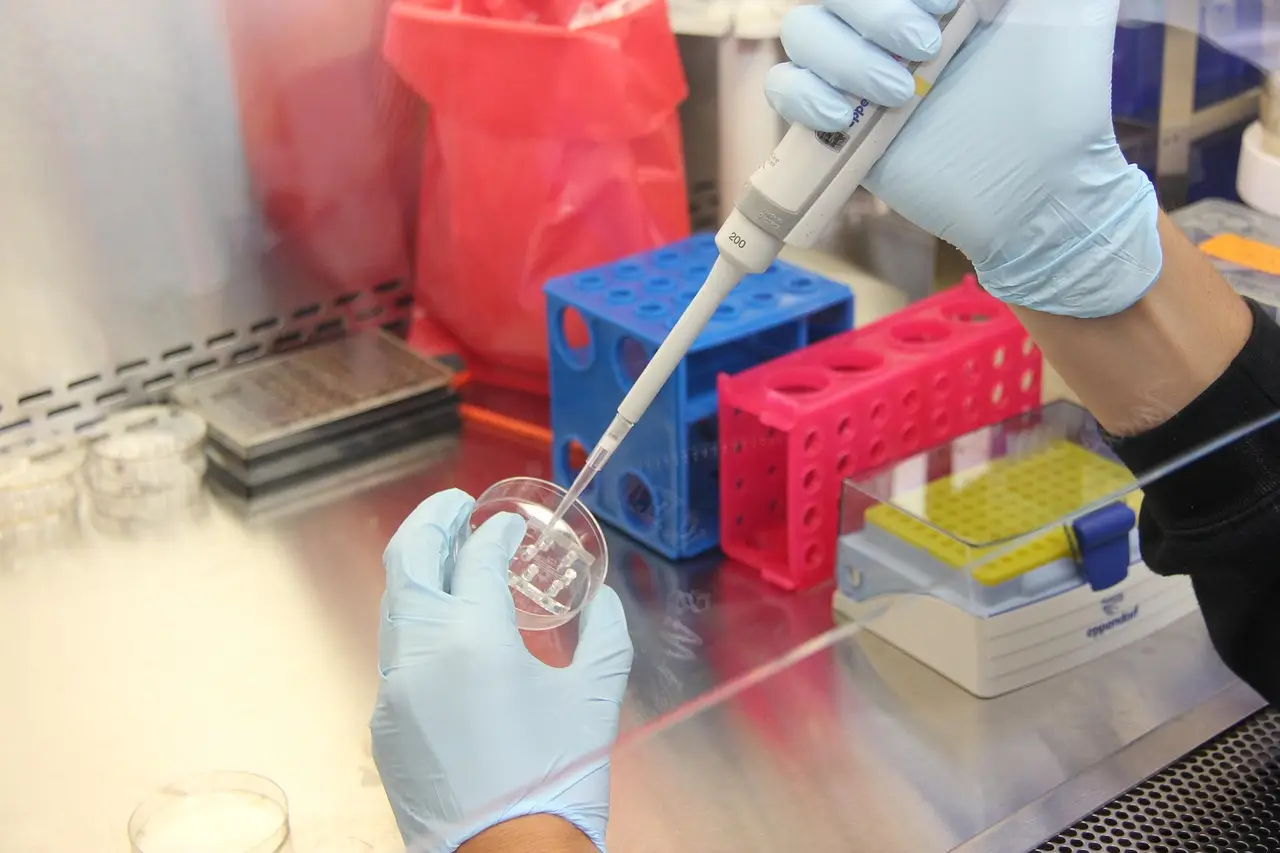
Beyond a single model, INFevo is building what it calls recursive scientific discovery. The system retains scientific questions, hypotheses, analytical methods and experimental results so they inform later hypotheses, experiment designs and candidate selection. Its automated wet-lab covers cell culture, perturbation and multi-omics measurement.
The loop works both ways: model predictions choose which experiments to run, and the resulting data test those predictions and feed the next round of model improvements.
On the hypothesis side, the Popper Project — named for philosopher Karl Popper — deploys research agents and professional databases to generate, challenge and refine testable hypotheses. It shows traceable reasoning chains, evidence gaps and proposed experiments. Its Karl Workbench has entered beta, with research records, accumulated evidence, supervision and iterative-improvement features that let researchers review judgments and resume earlier tasks.
What does the benchmark result really show?
Xinglian reported that an October 2026 retest on SciAgentArena placed Karl Workbench first overall in both single-cell and spatial omics when running on DeepSeek. The benchmark spans roughly 200 stepwise-verified tasks across drug discovery, single-cell omics, spatial omics, electronic health records and genetics, and it separates agent execution from evaluation.
Here's the practitioner's caveat. SciAgentArena's own authors found that no single agent dominated across tasks and domains. Current systems performed unevenly, struggled with novel discovery and self-directed exploration, and tended to execute requests even when the scientific premise was invalid. INFevo's reported lead covers DeepSeek in two omics categories — not broad scientific leadership.
Where clinical reality enters
INFevo is also joining a Beijing key laboratory led by Peking University First Hospital focused on liver, biliary and pancreatic tumor organoid culture and intelligent diagnosis and treatment. The collaboration aims to connect clinical questions, patient-derived organoid models, drug screening, AI analysis and clinical validation, with model predictions and organoid experiments informing each other.
Co-founder Yalong Zhao said the financing would support the foundation-model and automated-experiment infrastructure and accelerate the recursive-discovery system. Lipeng Lai, INFevo's other co-founder, is also XtalPi's co-founder and chief innovation officer.
The new capital funds both sides of the system — computational prediction and automated validation. The decisive test for pharma partners is whether developer-reported benchmarks and beta tools convert into repeatable performance on patient-derived samples and real research workflows.
Source: unite.ai
More from Nathan Brooks
Show full bio
News editor covering regulation, policy and their impact on entrepreneurship, startups and venture funding at Business Bearings.
2,231 articles