Singapore's Family Empires Face the Succession Question
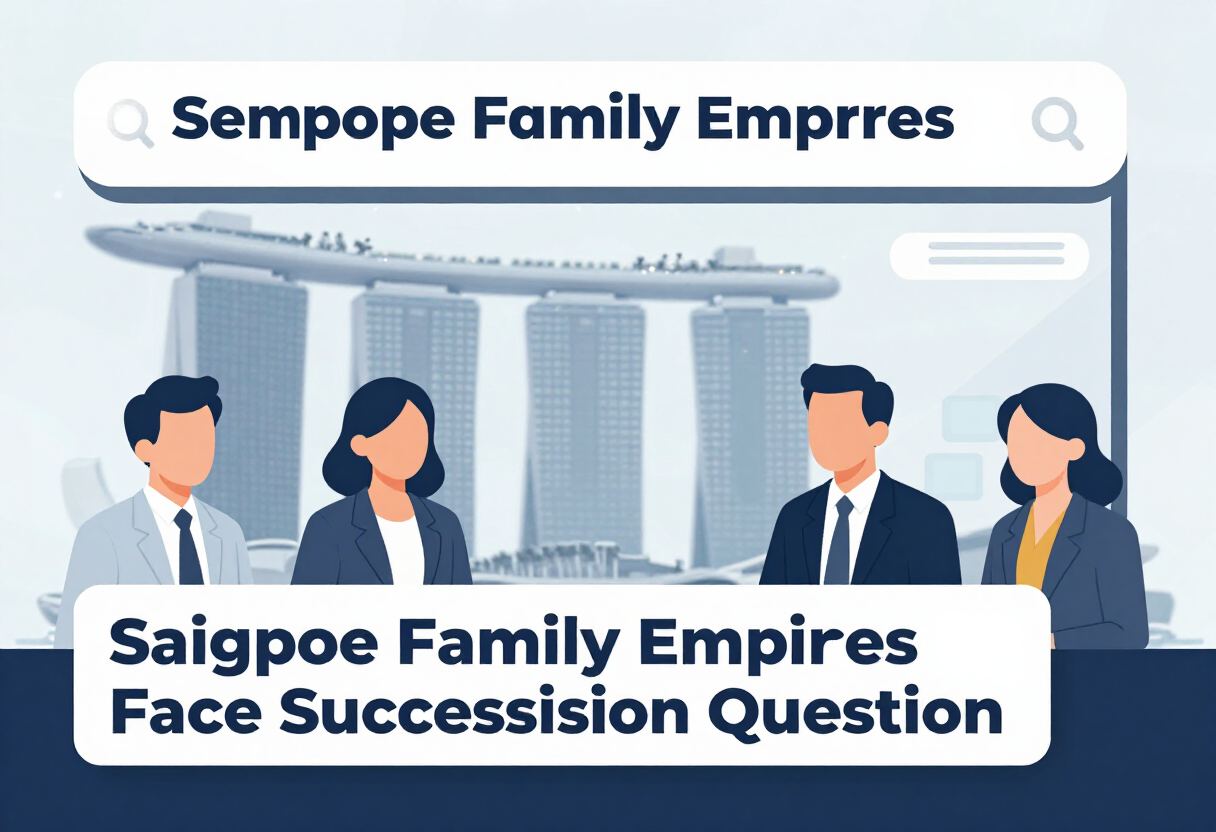
The Business Times asks whether Singapore's family empires are reaching their end, as succession, professional governance and generational dilution test the dynasty model.
By Olivia Hart
3 min read
Updated
What's News
- The Business Times posed the question of whether the era of Singapore's family empires is coming to an end.
- Succession is framed as the central fault line: the model depends on the next generation choosing to take over.
- The piece argues the empire model may be renegotiated rather than ended, with families retaining control while ceding operations to professionals.
The Business Times has raised one of the most consequential questions in Singaporean commerce: is the era of family empires coming to an end?
The question lands at a moment when succession has moved from the family dinner table to the boardroom agenda. Singapore's corporate history is, in large measure, the history of family-controlled businesses — trading houses, property groups, banks and industrial companies built by founders across successive generations. The Business Times' framing suggests that this model now faces pressures serious enough to ask whether it can survive in its recognisable form.
The title alone signals a shift in tone. Singapore's business press has traditionally treated family succession as a matter of planning and craftsmanship — how to hand over well. The phrasing chosen by The Business Times instead entertains the possibility of an ending. That is a stronger claim, and it deserves scrutiny.
What would end the era of family empires? The question posed by the newspaper implies several familiar fault lines. Succession is the most obvious. Every family firm, by definition, depends on the next generation choosing to take the reins. Where heirs decline, pursue other careers, or lack the appetite for the weight of an inherited enterprise, the empire model weakens at its core.
Professionalisation is another pressure. As companies scale and list, they face market and regulatory expectations that reward independent boards, institutional governance and meritocratic management over bloodline. Families can retain control through holding structures and voting mechanisms, but the operating reality bends toward professional executives.
Liquidity and generational dilution compound the problem. Each succession multiplies the number of family shareholders. Third- and fourth-generation families often hold stakes through dozens of cousins with divergent priorities. Some want to sell. Some want dividends. Some want control. Resolving those tensions frequently ends in a sale, a buyout, or a break-up — outcomes that dissolve the empire even when the underlying business thrives.
It is worth being precise about what the question does and does not claim. The Business Times poses its question with a question mark. That punctuation matters. It marks an inquiry, not a verdict. The newspaper is opening a debate about direction rather than declaring a death.
The counterargument is real. Family control remains deeply embedded in Asian capitalism, and Singapore is no exception. Family ownership brings long horizons, patient capital and a stewardship ethic that quarterly-driven public markets struggle to replicate. Many of the region's most resilient companies remain family-controlled, and several have navigated multiple successions without losing their character. If the era of family empires were truly ending, the evidence would show up in wave after wave of control sales — and the burden of proof sits with those who say that wave has arrived.
The more defensible reading of The Business Times' question is narrower and more interesting. The family empire may not be ending so much as being renegotiated. Families may increasingly hold wealth and control while ceding operations to professionals. Direct holding companies, family offices and trust structures may replace the tightly-run operating empire. The name on the building may survive even as the family exits the boardroom.
For investors, counterparties and executives in Singapore, the practical stakes are concrete. Succession events in family-controlled companies are moments of unusual volatility and unusual opportunity — for minority shareholders, for acquirers and for the professionals who step into founder-shaped roles. Reading the succession pipeline of any family-controlled Singapore group is now part of basic due diligence.
The Business Times has put the question on the record. The answer will arrive deal by deal, boardroom by boardroom, as each family decides whether empire is still the vehicle for its ambition — and whether the next generation agrees.
Source: GN: Family Business
More from Olivia Hart
Show full bio
Staff writer covering industry trends and analytics at Business Bearings.
228 articles