South Korea Puts $39 Million Behind Robot Muscles and Humanoid Batteries
Seoul's 2027 budget proposal earmarks $22.4M for robot actuators, $10M for humanoid batteries and $6.7M for on-sensor AI chips, with commercialization set for 2030.
By Nathan Brooks
3 min read
What's News
- South Korea proposed $22.4M for robot components, $10M for humanoid batteries and $6.7M for AI sensors in its 2027 budget.
- The actuator program targets 100 billion won ($74.8M) through 2029, aiming for fivefold force gains and 80% domestic sourcing by 2030.
- Humanoid battery research targets eight hours of continuous operation, with commercialization set for 2030.
- Plans were presented Nov. 11 at an emergency economic ministers' meeting chaired by Finance Minister Lee Hyung-il.
- Task forces under the Super-Innovation Economy Leading Project will meet before end-2026 to align financial, tax and regulatory support.
South Korea has proposed roughly $39 million in its 2027 budget for three core physical AI technologies: $22.4 million for robot components, $10 million for humanoid batteries and $6.7 million for AI-powered sensors. The plan, outlined at an emergency economic ministers' meeting in Seoul on Nov. 11 chaired by Deputy Prime Minister and Finance Minister Lee Hyung-il, sets development, testing and commercialization milestones running through 2030.
The figures break down to 30 billion won for core robot components, 13.3 billion won for humanoid batteries and 9 billion won for on-sensor AI semiconductors — chips that process information within or near sensors rather than shipping it to external servers. For context, the sensor allocation alone is a fraction of what a single major fab project costs, but it seeds a 49.8 billion won (about $37.3 million) multiyear program.
What does each program actually fund?
Next-generation sensors. The government plans a 49.8 billion won technology development program from 2027 through 2030, starting with the 9 billion won proposed for next year. Research will target on-sensor AI semiconductors for robotics, defense and mobility. The schedule calls for initial technology development in 2027, module prototypes in 2028, an integrated semiconductor module in 2029 and system demonstrations in 2030.
The sensor budget also includes:
- 1.8 billion won (about $1.3 million) for training specialized workers
- 1 billion won (about $750,000) for manufacturing infrastructure
- support for small and medium-sized chip design companies to produce prototypes
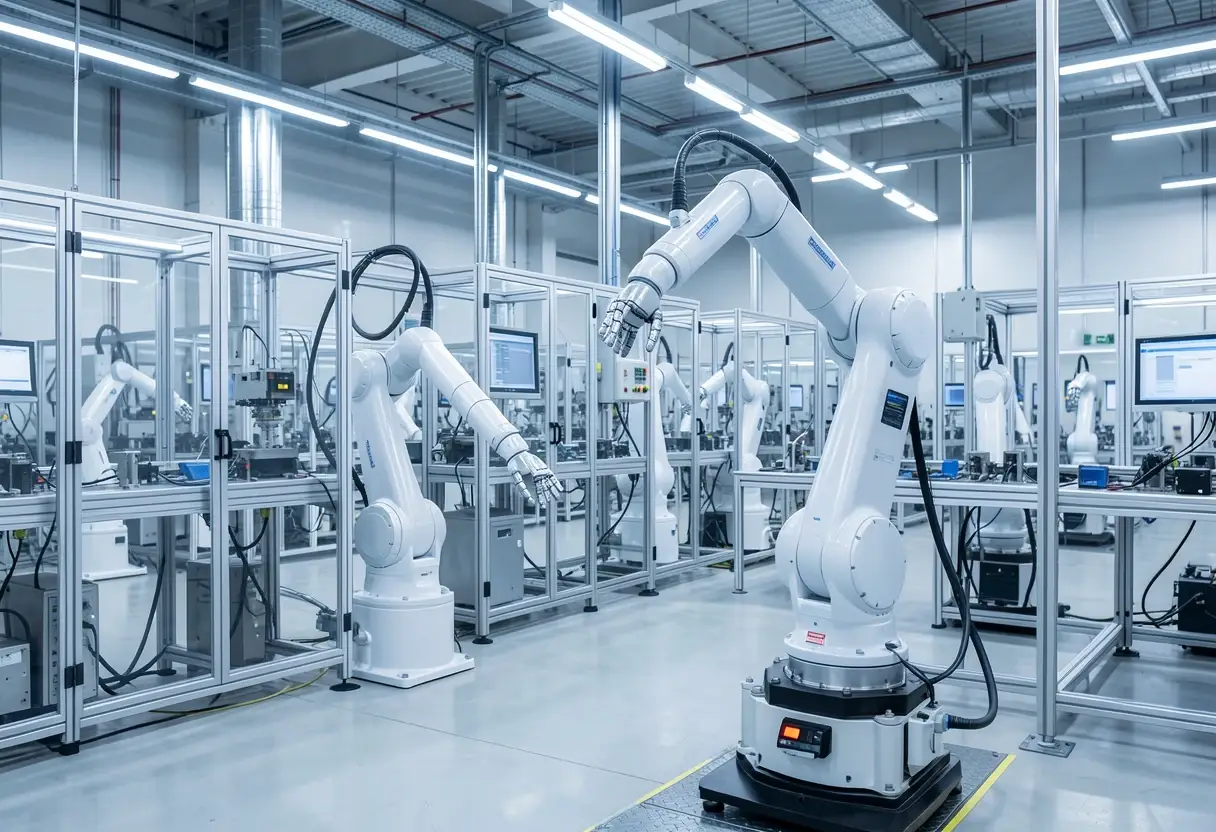
Robot actuators. South Korea plans to invest 100 billion won (about $74.8 million) from 2027 through 2029 in the components that move robotic arms, legs and fingers. The 2027 allocation of 30 billion won anchors that effort.
The performance targets are specific. The government wants lighter, more durable actuators producing roughly five times as much force at the same weight as current components, and capable of withstanding more than 1 million repeated operations. That durability bar — 1 million cycles — is the difference between a lab demo and a component that survives a factory floor.
About 3 billion won (about $2.2 million) is proposed for demonstrations next year, including testing components installed in humanoid robots at manufacturing sites to assess durability, accuracy and safety. Additional prototyping, testing and evaluation support is slated for after 2028, and financial assistance through the National Growth Fund is under consideration.
Domestic actuator production is slated to begin in 2029, with larger-scale manufacturing and exports in 2030. By that same year, the government wants an 80% domestic sourcing rate for core robot components.
Humanoid batteries. The 13.3 billion won allocation splits two ways: 5.7 billion won (about $4.3 million) for eight projects to improve commercial battery performance, and 7.6 billion won (about $5.7 million) for 10 projects focused on solid-state batteries and standards.
The headline requirement is eight hours of continuous operation, with short bursts of high power — the profile a working humanoid actually needs on a shift. Standards are scheduled for development in 2027, materials and cells in 2028, demonstrations in 2029 and commercialization in 2030.
What does this change for the industry?
For component suppliers and robotics firms, the answer is a dated pipeline rather than a windfall. Task forces for each initiative — designated in July under South Korea's Super-Innovation Economy Leading Project — will meet before the end of 2026 to identify industry needs and coordinate financial, tax and regulatory support, according to the government's policy briefing.
What does this change for practitioners watching the physical AI supply chain? It puts a timetable on Korean sourcing. If the 2030 targets hold — domestic actuator production from 2029, an 80% localization rate for core robot components, and commercial humanoid batteries by 2030 — Korean robot makers get an alternative to imported components, and foreign suppliers get a clear window in which to compete.
Source: theaiinsider.tech
More from Nathan Brooks
Show full bio
News editor covering regulation, policy and their impact on entrepreneurship, startups and venture funding at Business Bearings.
2,232 articles