Teraco switches on wind power in R3.5bn green energy push
Teraco begins receiving wind power in Cape Town under a R3.5bn programme targeting 100% renewables by 2035, as MTN revives Telkom takeover talks and Microsoft's 18-hour outage rattles South African business.
By Olivia Hart
5 min read
What's News
- Teraco began receiving wind power at its Cape Town data centres in September under a R3.5 billion ($200 million) renewable programme targeting 100% clean energy by 2035.
- MTN revived takeover talks with Telkom, whose 25 million subscribers would merge with MTN's mobile business; government holds 40.5% of Telkom.
- Microsoft's 18-hour November 13 outage disrupted Eskom, Absa, FlySafair, Cape Town and SARS.
- Verascient, a Cape Town AI startup, raised R19.5 million ($1.2 million) from investors including Founder Collective.
- South Africa's Competition Commission settled with X; four local publishers had earned a combined $914.25 from its creator revenue programme.
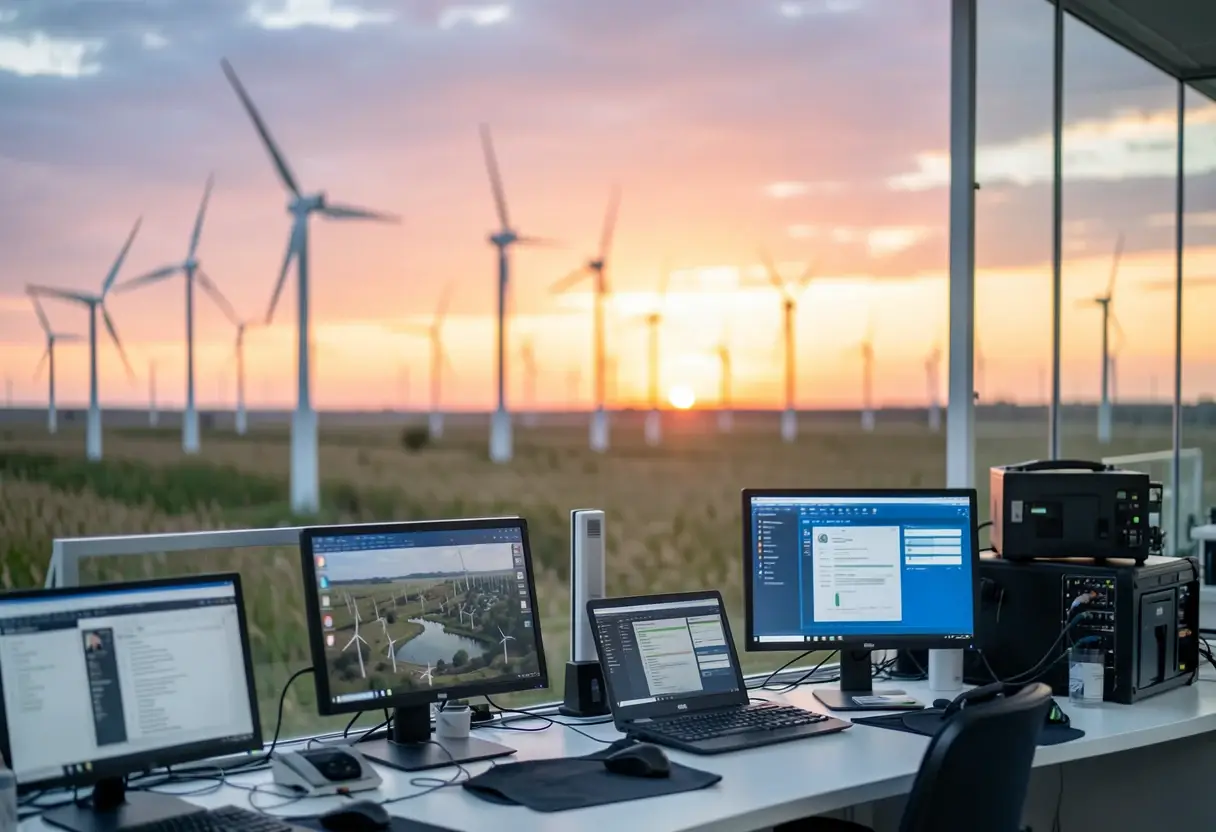
Teraco, Africa's largest interconnected data centre operator, has begun receiving wind-generated electricity through South Africa's national and municipal grids — the first tangible output of a R3.5 billion ($200 million) renewable energy programme. The first power from its contracted independent power producer wind project reached Teraco's Cape Town data centres in September. The programme combines solar generation, wind power purchases and grid infrastructure investment, anchored by Sediba, a 120MW solar plant under construction in the Free State backed by R2.25 billion. To put that in perspective, the solar component alone costs roughly two-thirds of the entire programme's budget.
Teraco targets 100% renewable energy by 2035, as demand for data centre capacity grows alongside cloud computing and AI. That is a decade away, and the company has not published interim milestones in this announcement. The takeaway: the region's biggest data centre operator is now spending real money on clean power, but the 2035 target remains a promise until more capacity comes online.
What is happening with MTN and Telkom?
MTN, South Africa's second-largest telecom group by subscribers, has revived takeover talks with its JSE-listed rival Telkom, four years after walking away. The proposed acquisition would combine MTN's mobile business with Telkom's 25 million subscribers, fibre network and enterprise operations. The obstacle map is crowded: the government owns 40.5% of Telkom and the Public Investment Corporation another 11.08%, and any deal faces shareholder, competition and regulatory hurdles. If it closes, it could rank among the biggest transactions in South Africa's digital economy.
Why did Ramaphosa's Silicon Valley trip cause a fight?
President Cyril Ramaphosa's 300-person delegation to Silicon Valley has sparked debate over public spending, diplomatic priorities and South Africa's AI ambitions. Ramaphosa defended the week-long visit, saying private companies covered much of the cost and that the mission could attract investment, build technology partnerships and position South Africa as an AI innovation hub. The delegation includes eight cabinet ministers, 24 startups, postgraduate AI students, researchers and business leaders, with engagements at Google, Microsoft, Cisco and Palo Alto Networks.
The president has refused to disclose the trip's total cost or identify its sponsors, fuelling criticism from citizens, former diplomats and political observers. Phathisani Moyo, head of TechCabal's South African desk, wrote: "South Africa needs global technology partnerships, but taxpayers deserve transparency and clear, measurable returns, not promises wrapped in diplomatic spectacle."
How bad was the Microsoft outage?
Microsoft's 18-hour global outage on November 13 disrupted South African businesses and public institutions, hitting Eskom, Absa, FlySafair, the City of Cape Town and the South African Revenue Service. The failure struck Microsoft 365 services — Outlook, Teams, OneDrive and SharePoint — forcing organisations to redirect customers and employees to alternative channels. One provider's failure rippled across banking, aviation and public services. The hard question the incident raises: South Africa cannot build a resilient digital economy while leaving critical services vulnerable to infrastructure it does not control.
What does the ICASA court fight mean for Starlink?
The Independent Communications Authority of South Africa (ICASA) will oppose lobby group Sakeliga's court application challenging the regulator's refusal to recognise equity-equivalent investment programmes as an alternative to 30% local ownership. Such programmes would let multinationals invest in skills development and enterprise support instead of selling shares in their South African businesses to historically disadvantaged groups. Sakeliga wants the High Court to overturn ICASA's decision, arguing the regulator failed to implement Communications Minister Solly Malatsi's policy direction aligning ownership rules with the ICT sector code. The case matters for Starlink, Elon Musk's satellite internet company, which could face ownership requirements before securing a licence.
Who raised money and who settled?
Emile Ferreira, co-founder and CTO of Cape Town-founded AI infrastructure startup Verascient, raised R19.5 million ($1.2 million) from international investors including Founder Collective, co-founded by South African tech entrepreneur David Frankel. Ferreira taught himself to code at 12, joined Replit as one of its first hires while still in high school, built an on-device AI assistant that reportedly reached more than 200,000 Android users, and graduated with distinction from the University of Cambridge with a master's in advanced computer science. Verascient helps organisations turn fragmented information into useful intelligence for AI agents.
Separately, South Africa's Competition Commission settled with Musk's platform X, requiring a two-year monetisation programme for qualifying local news publishers, to launch within six months, plus twice-yearly workshops on revenue tools, audience analytics and content strategies. X's AI arm, xAI, will train publishers twice a year on managing access to their content by the Grok chatbot. The deal guarantees no direct payments — notable given the Commission's finding that four local publishers earned a combined $914.25 from X's creator revenue programme.
What else moved across the region?
- Zambia: Airtel launched Airtel Money Buy Shares, letting customers buy Lusaka Securities Exchange shares via the MyAirtel app. FinScope's 2025 survey found 76.1% of Zambian adults use mobile money, while capital-market product usage rose from 0.6% in 2020 to 13.8% in 2025 — a 23-fold increase in five years.
- Zimbabwe: Cabinet approved a National Artificial Intelligence Charter operationalising the 2026–2030 National AI Strategy, setting principles on transparency, accountability and inclusion. Its business impact depends on whether the principles become enforceable rules.
- Malawi: Paratus Group launched Starlink-powered enterprise connectivity, extending its network to 16 sub-Saharan countries. The company says installations complete within 24 to 48 hours.
- Four countries: SES and the ITU's Partner2Connect coalition plan to connect 30 rural schools across Malawi, Burundi, Zambia and Zimbabwe by end-2026, benefiting 20,000 to 30,000 students and teachers.
- Payments: In TechCabal's Coffee With interview, former crypto sceptic Harry Huang discussed Lumepay, which combines stablecoins with banking infrastructure so African businesses can move money across borders — built around a simple expectation: the money must arrive.
Across these stories runs one thread: capital is flowing into Southern African tech — R3.5 billion in data centre energy, a $1.2 million AI seed round, a possible MTN-Telkom mega-deal — while regulators and outages test how durable that growth really is.
Source: techcabal.com
More from Olivia Hart
Show full bio
Staff writer covering people, launches and day-to-day practice in entrepreneurship, startups and venture funding at Business Bearings.
2,589 articles