Trump Floats Diesel Export Ban as Pump Prices Hit Record $6.52
President Trump says he backs banning U.S. diesel exports as prices hit a record $6.52 a gallon. Treasury is studying feasibility; analysts warn the move could backfire.
By Nathan Brooks
3 min read
Updated
What's News
- President Trump said Tuesday he supports a ban on U.S. diesel exports, speaking at the UN General Assembly.
- The national average diesel price hit a record $6.52 per gallon, up 77% year over year, according to AAA.
- Treasury Secretary Scott Bessent is studying feasibility; the U.S. produces 5.3 million barrels of diesel daily versus 3.6 million barrels of domestic demand.
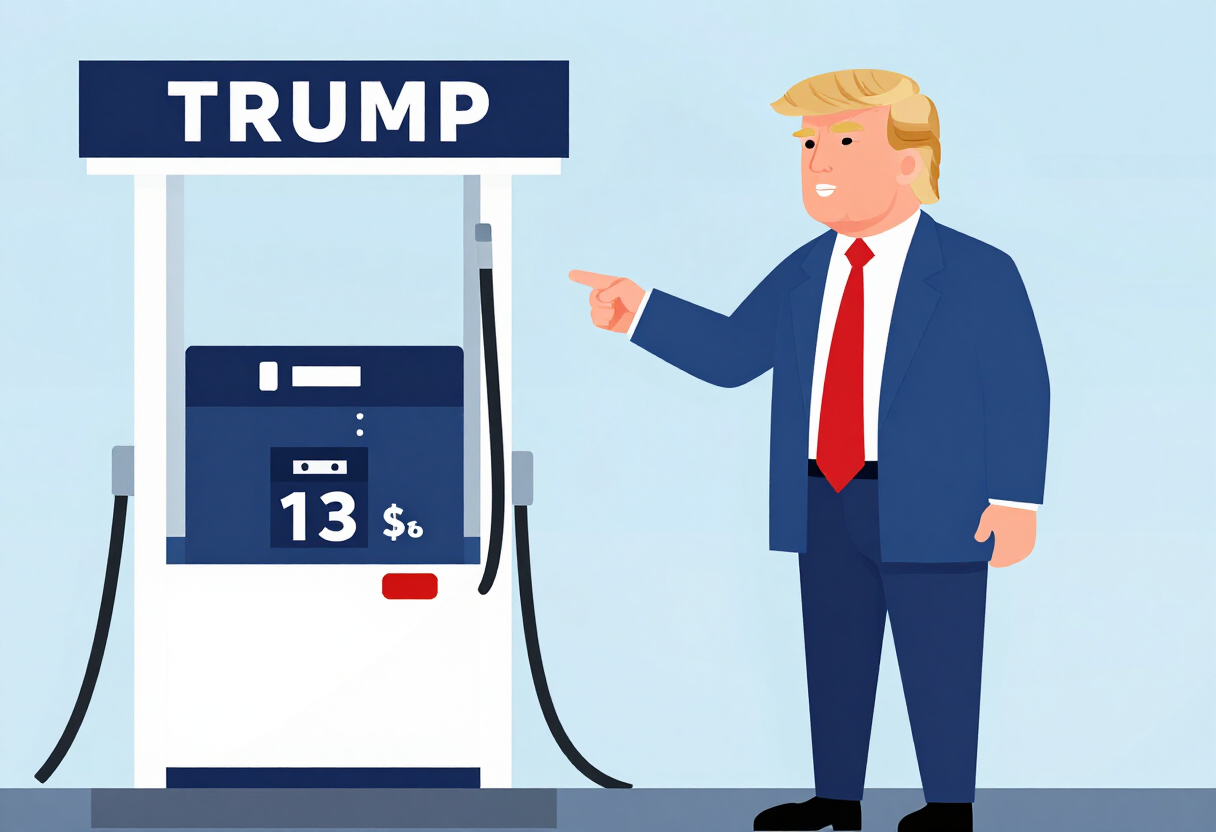
President Trump said Tuesday he supports banning U.S. exports of diesel fuel, a proposal now under feasibility review at Treasury as the national average diesel price hit an all-time record of $6.52 per gallon.
"I've said let's not send out the diesel," the president told reporters on the sidelines of the UN General Assembly. "We make a lot of diesel. It could have a little bit of an effect on regular automobile gasoline because when you do that, you know, it's a sort of a flow. It's a balance."
Trump added: "But no, I've called for it. I've called for it within my people. I've been talking about it."
Treasury Secretary Scott Bessent said he is examining whether a diesel export ban is feasible, weighing overall refining capacity and whether a full or partial ban would work. No timeline for a decision was given.
The price shock behind the proposal
The national average diesel price of $6.52 per gallon, according to AAA, marks a 77% increase compared with the same time last year. Global supply crunches driven by the wars in Iran and Ukraine are the primary cause of the spike, according to the source report.
The surge functions as a massive tax on the U.S. supply chain, which depends heavily on diesel to move goods. Because diesel is the economy's primary industrial fuel, its elevated cost is spilling over into consumer prices nationwide — a dynamic that puts the issue directly in the inflation debate and, by extension, in the political crosshairs of the White House.
The arithmetic behind the president's instinct appears straightforward. The United States produces 5.3 million barrels of diesel per day against domestic demand of 3.6 million barrels, leaving a surplus of roughly 1.7 million barrels daily that currently flows to export markets. Walling off that surplus, in theory, would flood the domestic market and push prices down.
Analysts see a backfire
Industry analysts argue the theory breaks down in a globally traded commodity market. Patrick De Haan, head of petroleum analysis for GasBuddy, posted on X: "this will backfire and is not good."
"U.S. diesel prices are determined not by a U.S. supply and demand balance, but a global one," De Haan wrote. "Keeping distillates and diesel [at] home does not change the world price that reference our prices. You can't fence off a globally traded commodity by executive order and expect the global price to stop applying to it."
Economist Joseph Brusuelas flagged a second failure mode: a production pullback. An export ban would create a short-term domestic surplus, which would then have to be sold at a discount. Persistently discounted prices could cause energy firms to cut output, tightening supply again and sending prices back up — an outcome that would reverse the intended relief and potentially leave consumers worse off than before the intervention.
What to watch
The immediate variable is Bessent's feasibility study, which will determine whether the administration pursues a full ban, a partial restriction, or drops the idea entirely. The refining-capacity question the Treasury Secretary raised is central: U.S. refineries are configured to produce more distillate than the home market absorbs, and reconfiguring that output takes years, not executive orders.
For businesses, the so-what is a period of policy uncertainty layered on top of an already record price environment. Fuel-intensive sectors — trucking, agriculture, logistics — face a scenario where diesel stays elevated regardless of the ban's fate, because, as De Haan notes, the reference price is set globally. If the administration proceeds anyway, watch domestic diesel discounts and producer rig counts as the first signals of whether Brusuelas's warned supply response materializes.
Original: gasprices.aaa.com
More from Nathan Brooks
Show full bio
News editor covering marketplaces and e-commerce at Business Bearings.
242 articles