Warren Buffett Exits Berkshire Chairman Role at 96
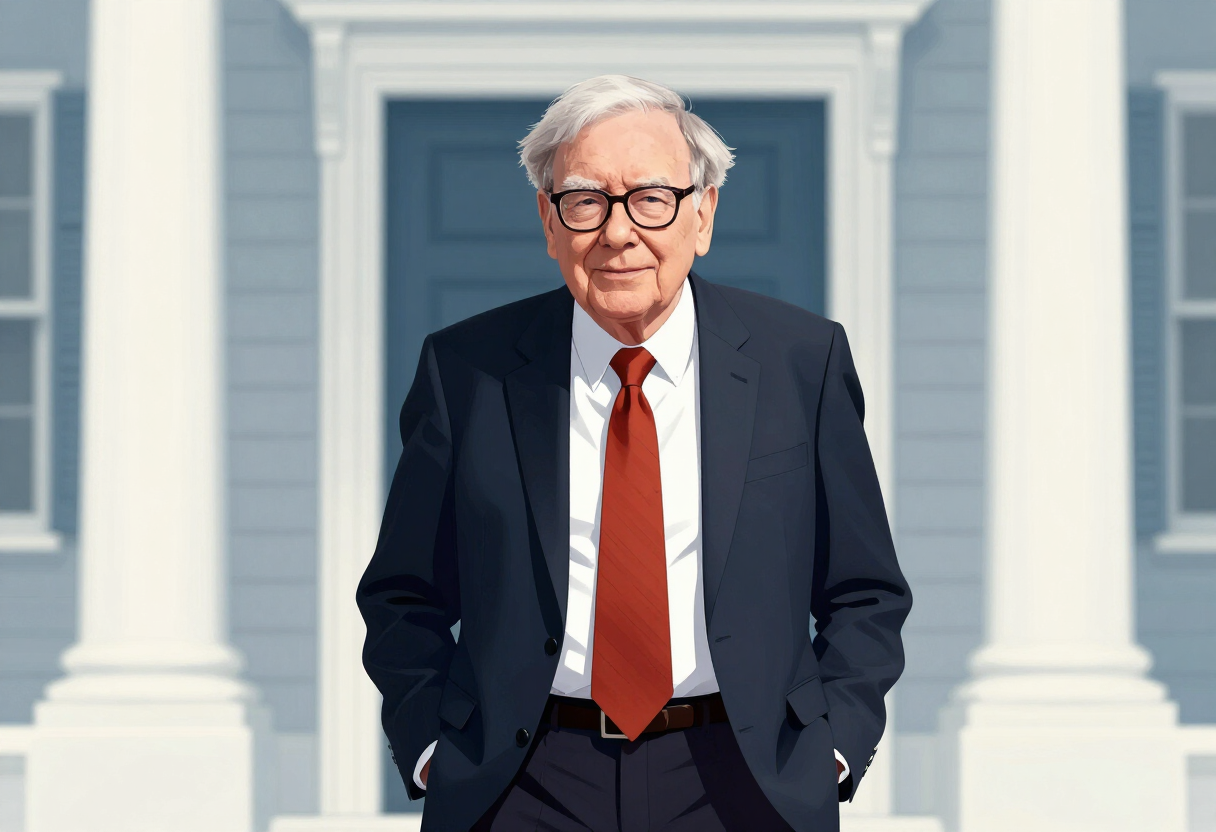
Warren Buffett, 96, is leaving the Berkshire Hathaway chairmanship after 56 years, handing the role to son Howard while staying on as chairman emeritus and board member.
By Daniel Okafor
3 min read
Updated
What's News
- Warren Buffett is stepping down as Berkshire Hathaway chairman after 56 years on the board, at age 96.
- Howard Buffett, a Berkshire board member for 33 years and Warren's eldest son, becomes chairman; Warren Buffett remains chairman emeritus and a board member.
- Berkshire is the only non-tech U.S. company with a market cap above $1 trillion, built on holdings in insurance, railroads, retail and energy, plus Apple.
Warren Buffett is giving up the chairman post at Berkshire Hathaway (BRK.A, BRK.B), closing a 56-year run at the head of the board less than two years after stepping aside as chief executive. He is 96. His eldest son, Howard Buffett, who has sat on the board for 33 years, will replace him as chairman. Warren Buffett will stay on as chairman emeritus and remain a member of the board, according to a statement to shareholders.
The move completes a succession that began when Buffett ended his tenure as CEO at 94, a decision that surprised the investing world despite years of mounting speculation about his retirement. Buffett built Berkshire from a faltering textile business into one of the largest conglomerates on the planet.
In his statement, Buffett framed the handover with characteristic bluntness. "Father Time always wins. He has, however, been generous with me. He has given me the opportunity to see Berkshire reach a point where I am more confident than ever about what lies ahead," he said.
He directed his confidence squarely at the current chief executive, whose grip on the job he described in detail. "My expectations for him were sky high from the start, and he has exceeded them. He has taken hold of the chief executive officer job in every respect. He has been making the decisions that matter for some time now, and I have not had to think twice about any of them," Buffett said.
That last line matters for BRK.B holders. Buffett is telling the market that the operating decisions have already been flowing through the new CEO for some time, and that the chairman transition changes governance form rather than investment substance. Howard Buffett's three decades on the board also mean the incoming chairman knows the company's culture, its managers and its owners intimately.
The legacy Buffett leaves behind is measurable. Under his leadership, Berkshire became the only non-tech company in the United States with a market capitalization above $1 trillion. That is a striking feat for an investor who avoided technology stocks for most of his career—until he made Apple (AAPL) one of Berkshire's biggest holdings. Apple itself is navigating its own leadership transition, having named John Ternus as its new CEO.
Buffett's portfolio, for the most part, stayed in what the market calls unglamorous corners: insurance, railroads, retail and energy, among others. These were not trophy assets. They were businesses with solid management, wide moats that competitors could not easily breach, and intrinsic value above their prevailing market prices. Those three criteria—management quality, durable competitive advantage and a discount to intrinsic value—form the basic tenets of Buffett's investing philosophy, and they explain how a conglomerate built on insurance floats and freight rails reached a trillion-dollar valuation.
For shareholders, the question now is whether the market prices Berkshire on its fundamentals or on the Buffett name. The 96-year-old's continued presence on the board as chairman emeritus provides continuity, while his son's elevation keeps the founding family formally attached to governance. The transition formalizes what Buffett himself describes as an already completed transfer of decision-making power—suggesting the real test for the stock is whether the next generation can keep finding those unglamorous businesses at prices below what they are worth.
Original: barchart.com
More from Daniel Okafor
Show full bio
Correspondent covering business strategy at Business Bearings.
234 articles