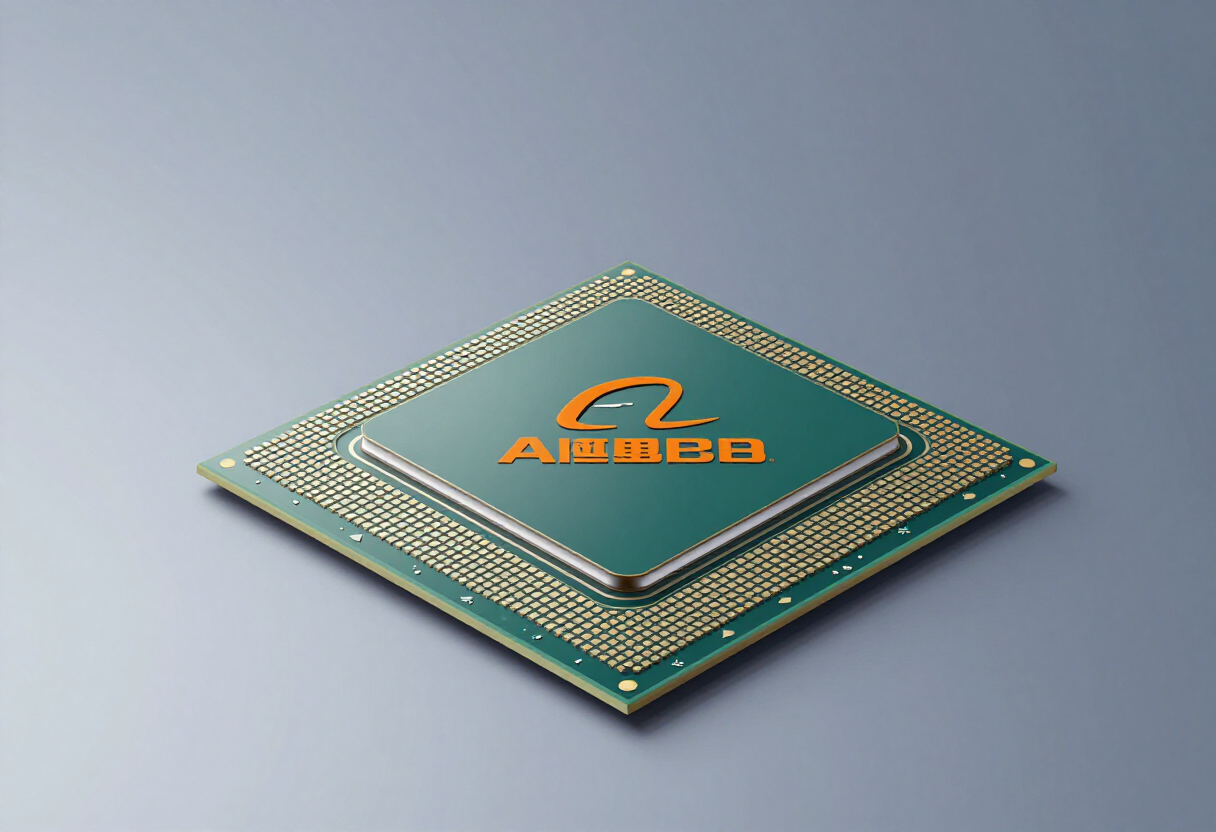
Alibaba Unveils Zhenwu V900 AI Chip Three Times Faster
Alibaba's Zhenwu V900 accelerator promises triple the performance with mass production in early 2027, while Qwen models scale toward 10 trillion parameters and data-center capacity passes 20 gigawatts.
By Grace Kim
3 min read
Updated
What's News
- Alibaba unveiled the Zhenwu V900 AI accelerator on September 22, claiming roughly 3x the performance of its predecessor, with mass production scheduled for early 2027.
- Alibaba plans future Qwen models of 5–10 trillion parameters and global data-center capacity above 20 gigawatts by 2032.
- Hedge fund longs in Alibaba fell to 97 in Q2 2026 from 102 in Q1, while Nvidia holders rose to 285 from 275; Alibaba short interest was ~41.98 million shares, about 2.0% of float, as of August 14.
Alibaba unveiled an AI accelerator it says delivers roughly three times the performance of its predecessor, with mass production scheduled for early 2027. The Zhenwu V900, announced at the company's September 22 developer conference, is the clearest signal yet of how fast China's AI stack is filling the holes left by restricted access to U.S. chips.
Alongside the chip, Alibaba Group Holding Limited (NYSE:BABA) laid out plans for future Qwen models scaling to 5 trillion to 10 trillion parameters and a global data-center capacity target above 20 gigawatts by 2032. For NVIDIA Corporation (NASDAQ:NVDA), the issue is not today's China revenue. It is whether a protected local ecosystem becomes good enough that customers stop waiting for Nvidia to return.
The vertical-integration bet
Alibaba can deploy a homegrown accelerator across its cloud, its models and its internal applications. That gives the company a captive workload before it ever sells the chip broadly. This vertical integration is the bull case: if Zhenwu performance improves while Qwen demand rises, Alibaba captures cloud revenue without paying an outside GPU vendor for every incremental unit of compute.
The 20-gigawatt capacity target suggests Alibaba is preparing for a much larger infrastructure footprint than it operates today. The company is effectively building the full stack at once — silicon, models and data centers.
The caveats are concrete. The V900's performance claims come from Alibaba itself, and mass production remains two-plus years out. A chip can benchmark well and still struggle with yields, software tooling, memory supply or developer adoption. Alibaba is also financing AI aggressively while its core commerce business must keep producing the cash that pays for the buildout.
Nvidia's China problem turns structural
Nvidia still owns the stronger global platform. CUDA, networking and its pace of system-level launches make replacement hard. Export restrictions have already reduced Nvidia's ability to serve China's highest-end demand, which means Alibaba's progress may initially replace sales Nvidia is largely unable to make under current restrictions anyway.
The longer-term bear case is different. Local customers are being forced to optimize around domestic hardware, turning a temporary supply constraint into permanent ecosystem learning. Every quarter that Chinese engineers build on Zhenwu and Qwen rather than waiting for Nvidia makes the moat harder to reclaim once restrictions ease.
What the hedge funds are doing
Insider Monkey's database showed 97 hedge funds with reportable Alibaba long positions in Q2 2026, down from 102 in Q1. Fisher Asset Management held about 5.10 million shares after trimming its position by 1%. Nvidia moved the other way: 285 hedge-fund holders, up from 275, with Fisher increasing its stake roughly 3%. Those filings predate the V900 launch.
Alibaba short interest stood at about 41.98 million shares as of August 14 — roughly 2.0% of public float, with around 4.6 days to cover.
The numbers investors should watch now are execution milestones: whether Zhenwu hits its early-2027 mass-production date, whether Alibaba confirms the 20-gigawatt buildout with capital spending, and whether Chinese cloud customers shift meaningful workloads onto domestic silicon ahead of schedule.
Source: Yahoo Finance
More from Grace Kim
Show full bio
Market editor covering industry trends and analytics at Business Bearings.
234 articles