Nvidia shares plunge 13% as Jensen Huang’s exit tests AI supply chains
Nvidia shares plunged 13% in early trading after CEO Jensen Huang’s departure. The chipmaker’s GPUs, neocloud financing, sovereign AI deals and TSMC ties now face a succession test.
By Grace Kim
5 min read
What's News
- Nvidia shares plunged 13% in early trading after Jensen Huang’s departure.
- In 2025, Huang met Mohammed bin Salman, Keir Starmer and Emmanuel Macron to promote sovereign AI.
- Nvidia appeared to promise South Korea 260,000 advanced chips; delivery, payment and terms were unclear.
- TSMC’s yield rate for its most advanced chips is only 60%, meaning 40% are defective.
- Megaspeed reportedly secured roughly $7.5bn (£5.67bn) of Nvidia chips allegedly smuggled into China.
By Grace Kim
Nvidia shares plunged 13% in early trading after chief executive Jensen Huang’s departure. The sell-off exposed the risk in Nvidia’s rise: the report identifies the chipmaker as the world’s second-most valuable company, after periods when it ranked first globally.
The report attributes Nvidia’s sky-high valuation to the company’s design and sale of advanced graphics processing units, or GPUs. Those chips underpin the AI economy. According to the report, AI models such as ChatGPT and Claude could not be trained or run without the hardware, making Nvidia arguably AI’s most consequential player.
What makes Nvidia hard to replace?
The report says Microsoft, Meta and Google are developing their own AI chips, so Nvidia does not have a monopoly. Google’s tensor processing units, or TPUs, appear at least as good as Nvidia’s and may perform better for certain purposes.
Nvidia’s deeper advantage is a web of corporate and government relationships, much of it built by Huang. The report casts him as AI’s kingmaker and links his relationships to companies building AI infrastructure, creating circular financing that connects Nvidia, US tech giants and governments worldwide.
The result is more than a chip supplier. The report calls Nvidia the “central bank of AI,” with capital and influence running through nearly every layer of the AI economy. Nvidia’s advantage now rests on relationships as much as chip performance.
How does Nvidia finance the AI buildout?
In 2025, Huang met Mohammed bin Salman, Keir Starmer and Emmanuel Macron, among other world leaders, to persuade them of the urgency of developing “sovereign AI” with Nvidia’s products. The report says his presence served as a guarantee for national AI plans, followed by arrangements to supply scarce chips.
Transparency was limited. Nvidia appeared to promise South Korea 260,000 advanced chips, but delivery dates, payment terms and the identity of the payer were not immediately clear. Similar opacity complicates any assessment of what governments received and when.
Nvidia also financed “neoclouds,” which bought chips, installed them in datacentres and rented the capacity to the world’s biggest AI companies. This arrangement supported chip demand while keeping the risks of building datacentres and finding customers off Nvidia’s balance sheet.
The chipmaker invested in AI startups that could become future customers and offered massive cash sums to OpenAI for chip purchases. The report says this web of investments runs to hundreds of billions of dollars, with Nvidia’s money repeatedly circulating through a limited set of accounts. In short, Nvidia finances much of the demand for its own chips.
Can TSMC hold the chain together?
Nvidia’s pivotal manufacturing partner is TSMC, the Taiwan Semiconductor Manufacturing Company. The report says TSMC manufactures the overwhelming majority of the world’s AI chips at several fabrication plants in northwestern Taiwan, has no real competitor and may be more important geopolitically than Nvidia or any other chip designer.
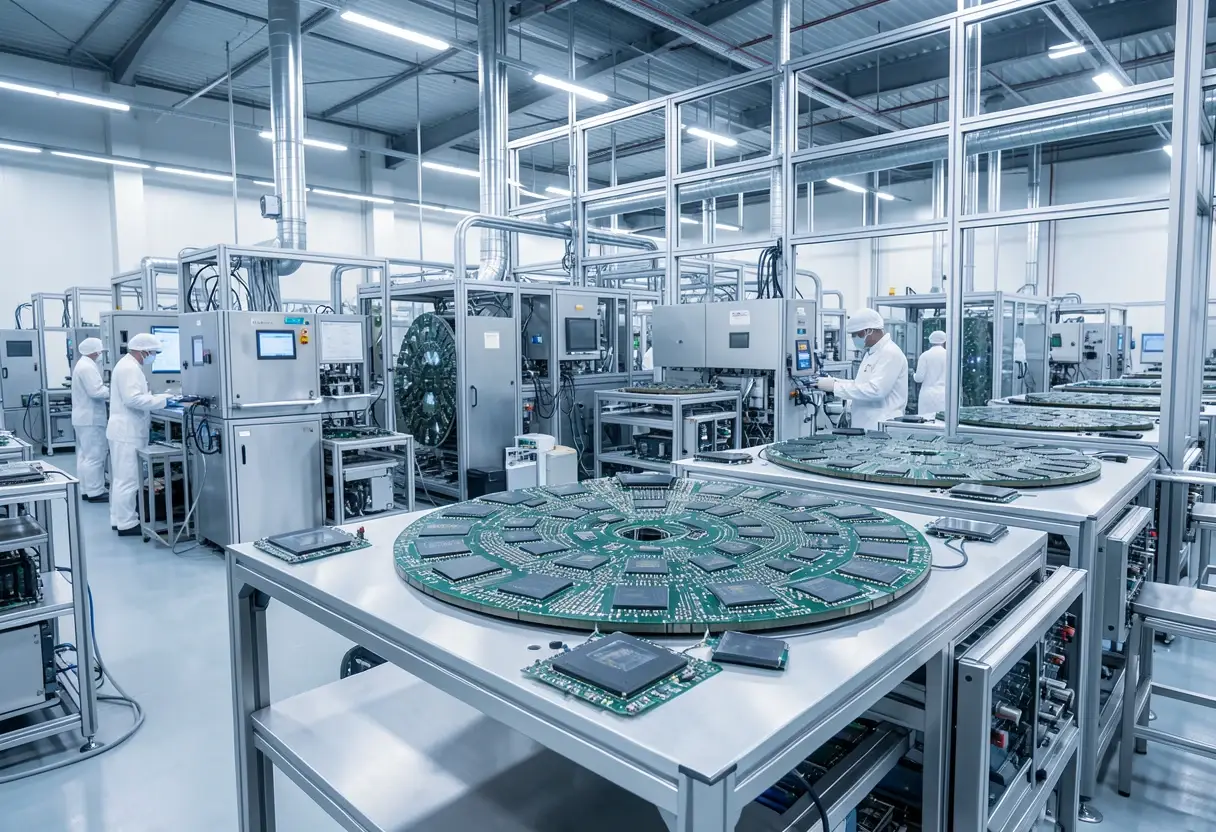
The report calls advanced-chip manufacturing one of humanity’s most expensive and difficult industrial processes. Each chip is etched with nanometre lines by lasers working in the extreme-ultraviolet spectrum, tools that cost billions of dollars and two decades of research to develop. TSMC has refined its process for more than two decades.
Its most advanced chips yield at just 60%. That means 40% of chips coming off the production line have defects, a high failure rate for technology of this cost and complexity. For Nvidia, TSMC’s yield remains a more immediate constraint than the ability to design another chip.
The report credits Nvidia with helping TSMC develop its processes and products and with a unique role in TSMC’s position as the unrivalled GPU producer. Company lore says Huang wrote TSMC’s chief executive a personal letter introducing himself in 1997, nearly 30 years ago.
These are high-trust relationships built over decades that rivals cannot match. A weaker bond with TSMC would weaken Nvidia regardless of demand for its chip designs.
What does Huang’s departure expose?
Nvidia’s contracts and export records remain secretive, making its supply chain unusually difficult to track. The report says investigators following the chain cannot fully determine who occupies the years-long queue for chips, in what order customers receive them or how many units have shipped.
Megaspeed, a small Singaporean company, illustrates the concern. It obtained access to large quantities of cutting-edge GPUs while other buyers struggled. The report says Megaspeed executive Alice Huang had an affair with Nvidia’s chief executive and was alleged to be a Chinese spy. That relationship appears to have helped Megaspeed secure roughly $7.5bn (£5.67bn) of Nvidia chips allegedly smuggled into China.
A new chief executive could bring more transparency and predictability to chip contracts and supply chains, the report argues. More scrutiny could also uncover elaborate debt structures and handshake agreements hidden inside Nvidia’s network. The report leaves unresolved whether Huang’s political glad-handing created the opacity or merely reflected a system designed to conceal it.
Huang’s leather-jacketed image helped persuade government leaders that Nvidia’s technology held the keys to transformation and power. His successor will need to preserve that influence while disclosing more about the capital, contracts and export flows underpinning the company’s valuation. The next proof point is whether Nvidia can become more transparent without losing the government and corporate access Huang cultivated.
Original: youtube.com
More from Grace Kim
Show full bio
Market editor covering people, launches and day-to-day practice in entrepreneurship, startups and venture funding at Business Bearings.
1,985 articles